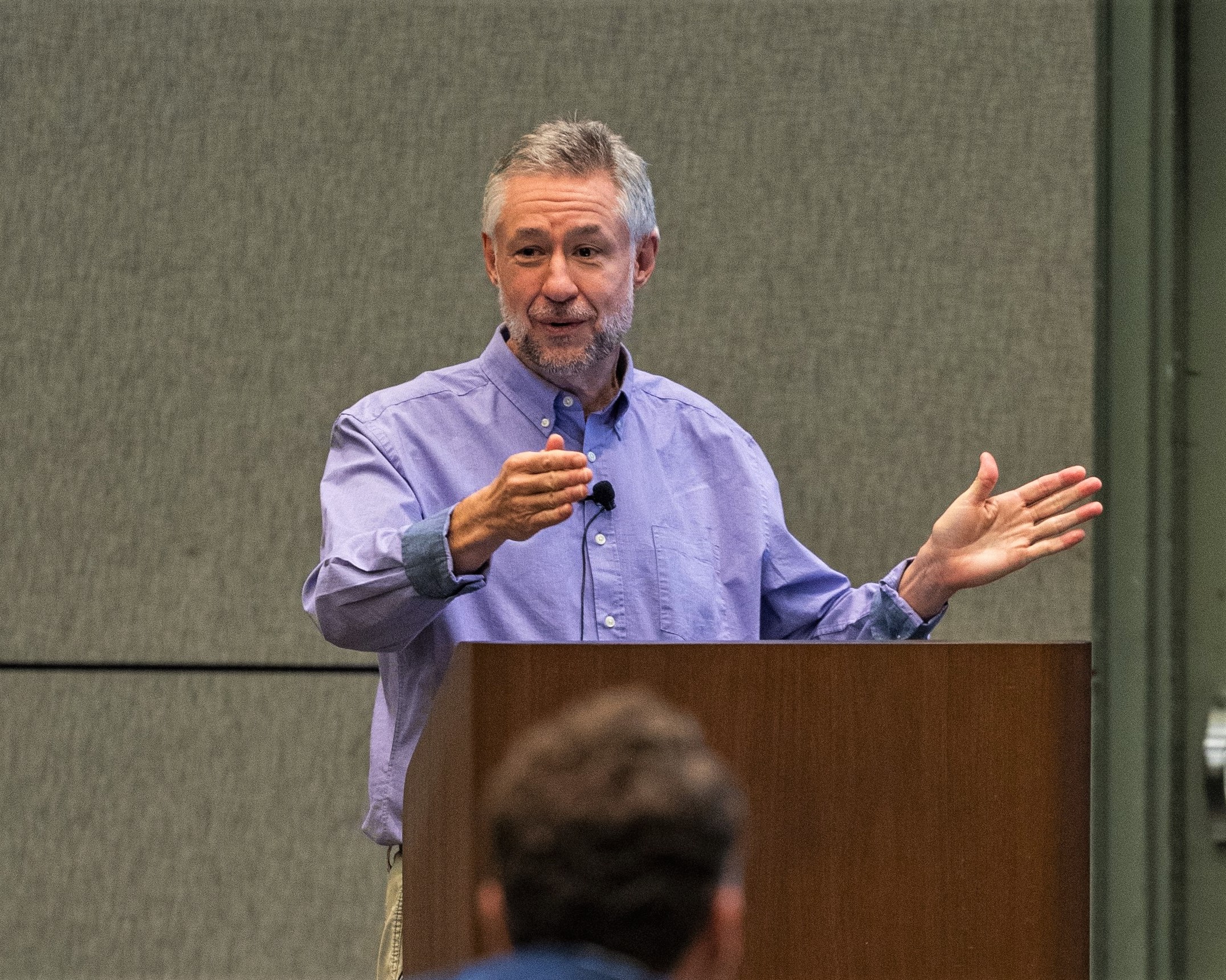
Steve Wright is an award-winning Universal Design consultant, writer, public policy expert and advocate for people with disabilities who Jane Jacobs biographer Jenna Lang once dubbed “the Jane Jacobs of Universal Design.” He created and taught a groundbreaking Universal Design course University of Miami and has lectured on the subject nationally and globally. Along with conducting Universal Design workshops for dozens of clients, he has published thousands of articles on planning for an inclusive built environment. Wright has worked at some of the nation’s leading urban design, architecture and mobility engineering firms.
Wright is featured the nation’s preeminent expert in design and public policy to increase quality of life for people who use wheelchairs for mobility in “Mark – A Call to Action.” The 90-minute disability positive documentary by an Emmy-winning producer-director premiered in Tokyo to a host of U.S. State Department Officials and renowned Japanese disability advocates. Wright is an acclaimed visual artist who has exhibited fine art photographs from his urban work in Tokyo, Istanbul, Paris, Barcelona, Marrakech, Cairo, Lisbon, London, Buenos Aires, Rio de Janeiro, Samarkand, Montevideo, Bogota, Mexico City, Prague, Medellin and countless major cities in North America.
This article is written by Steven Wright himself, exclusively for Disrupt MAG.


Call me the accidental urbanist.
I never dreamed I would be speaking around the world and the U.S. on Universal Design and how to make cities better and more inclusive for all people – especially those with disabilities.
My first dream was to be a major league baseball player. Let’s just say if there really were deals with the devil, I’d have played third base for the Cleveland Guardians for a decade and my soul would have been headed to a very hot and uncomfortable place.
When it turned out I was not so great at hitting a baseball, I figured I’d be a sportswriter covering a major league team. My dad worked in the back shop of the Akron Beacon Journal, so I figured he could help me get a foot in the door and soon I’d be writing about walk-off home runs and near no hitters.
My other dream was to become an author. My mom battled with severe mental illness her entire adult life. During my upbringing in the exurbs of northeast Ohio, she was institutionalized and put on heavy medication regimens.
I figured her first born son could tell her stories as a way of casting off the 1970s middle class suburban stigma of seeing psychologists, psychiatrists and spending time in a mental health ward.
I graduated with a degree in journalism, covering the losingest major college football team in the nation while at Kent State. I was on my way to being a pro sports beat writer.
Then I found out I was starting at the bottom. Night school board and town council meetings in the hinterlands. I was promoted (sentenced?) to the City of Columbus Development Commission – a board that met well into the wee hours – too late to beat deadline for the morning paper.
I also married young, to a person who used a wheelchair for mobility. The combination of learning about how “planning nerds” and developers operated + my spouses’ mobility needs + my deep human empathy gained through watching my mom’s tortured days – forged my career.
Along with covering growth and development for a large and influential Midwest newspaper in the 1990s, I was the guy tapped for the disability stories – including deciphering the new Americans Disabilities Act. The ADA, the strongest federal civil rights legislation for people with disabilities, became the law of the land in 1990.
On election day 2000, my wife and I landed in Miami. She soon was working as an ADA coordinator for a diverse city and I was the senior urban policy advisor for the Chair of the City of Miami Commission. After a dreadful period, Miami was booming and I was the point person to figure out whether hundreds of huge development proposals were good or bad for the city, Ta-da, once again starting meeting at 9 a.m. and working well past midnight!
My job also allowed me to hold some city and private sector leaders’ feat to the fire – guaranteeing the ADA was met and exceeded.
I remember catching a horrible barrier created in the drawings for a brand new sky bridge that would serve tens of thousands. A well-meaning city department head told me not to worry, it would surely be corrected “because everything has to be ADA.”
I replied that people have to be kept in line. My analogy: murder, assault, robbery, burglary and fraud illegal – but lots of people break the rules if we do not police them.
The same applies to civic projects. Today, even more than a third of a century after the adoption of the ADA, I still get affordable housing developers trying to pass on the cost of accessible units – to the people with disabilities who could not afford to make the modifications in ten lifetimes.
I get engineers are aghast at the idea of a road diet – taking away a lane of speeding, dangerous traffic and using that space to widen sidewalks to enhance safe mobility – for wheelchair users and all pedestrians.
I get architects who say “it’s a fire house, no wheelchair user will work there” when the very same architecture firm has repurposed an old firehouse into a senior center, day care or even two-level restaurant – where wheelchair access is needed on all floors.
For that matter, if the second floor of a fire house couldn’t be reached by elevator – a decorated, retired, disabled firefighter could not visit his/her old workmates, or give a lecture on evacuation technique best practices for people with disabilities.
Call me the Universal Design Evangelist. The Pied Piper of inclusion for all. Jane Jacobs biographer Jenna Lang once dubbed “the Jane Jacobs of Universal Design.”
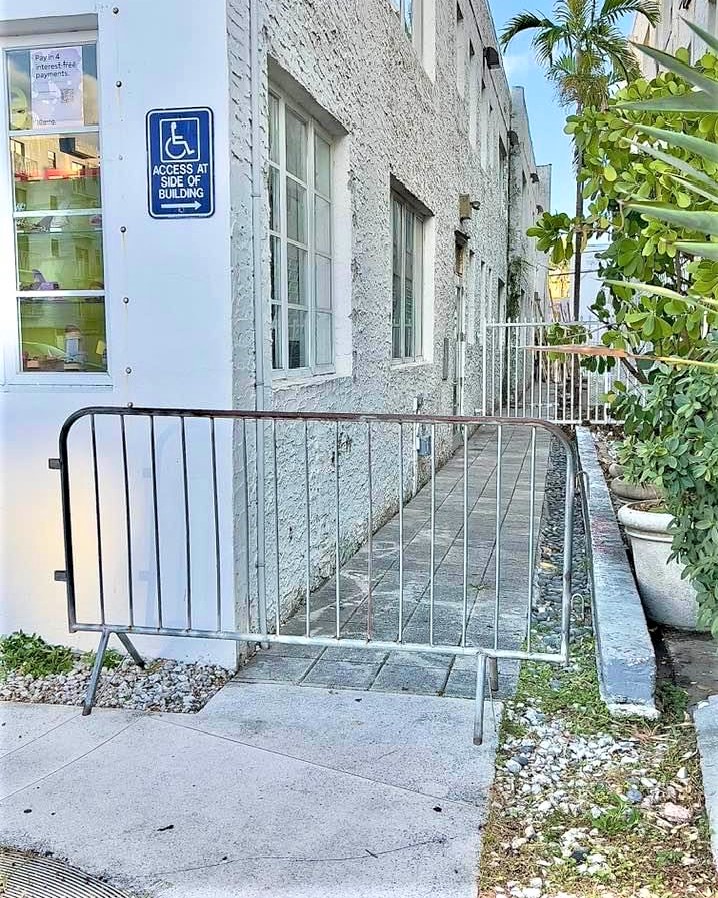
I was a direct caregiver to a person who battled chronic pain, dozens of surgeries and used a power wheelchair for mobility. I might not be able to stamp plans like an architect or engineer – but for 35 years, I saw first-hand the humiliation of using a wheelchair ramp in an unlit back alley – at a brand new building that should have featured access at the main entrance.
I have seen the isolation – and its detrimental mental and physical health impact – created by parks, schools and city halls that are not fully accessible.
I should note two things. If you are in the design field, you MUST remember that the ADA is the FLOOR, not the CEILING.


I would be on the Forbes richest people on earth list if I had 10 bucks for every time a planner, architect or engineer said “well, it may not work well, but it’s technically ADA compliant.”
What is that? Do you ever hear an architect saying “well, the roof is made of paper and will fall in within a matter of months, but if it passes inspection to get a certificate of occupancy, we’ll go home and pretend we didn’t design crap.”
But outdoor lifts – instead of less costly, low maintenance ramps – are routinely used as the only way for a person with a disability to access a condominium complex, apartment building, office block or mixed-use main lobby. They may meet code, but they are operated with a key that always goes missing. They break down because they require intense maintenance. If they are in a nightlife district with lots of bars, they tend to be used as de facto restrooms – for No 1, No 2 and vomit.
How can you be in the design business and pretend not to see this? How disingenuous is it to say your studio designs for all, but you create a 400-unit apartment buildings – with 100 reserved to be affordable/accessible dwellings – accessed by an outdoor lift doomed to fail in less than a year of operation.
For the record, I have surveyed 100 lifts in Miami-Dade County. More than 95% were nonfunctioning. Many had been blocked by a potted plant. Others led to locked doors.
My second upfront point is that I did not invent Universal Design. That honor goes to the late architect and planner Ronald L. Mace, FAIA, founder of the Center for Universal Design at North Carolina State University, who coined the term universal design.
He defined it as "the design of products and environments to be usable by all people, to the greatest extent possible, without the need for adaptation or specialized design."
Note how Mace, who used a wheelchair for mobility, did not name it disability inclusion design. His genius understood that when you design without barriers – EVERYONE BENEFITS.
The ramp and wide sidewalk may be essential for the person who uses a wheelchair. But the lack of steps also removes a tripping hazard. Wide sidewalks benefit young families pushing strollers. Curbramps are beloved by the armada of delivery professionals rolling hundreds of pounds of goods through the central city as e-commerce and online buying expands.
While Universal Design serves all ages well, it is a must for people with disabilities. Sadly a, a lot of professionals who design and regulated the built environment – cling to some wrong-headed noting the disability is an outlier. The snide part of me says that perhaps they have built so many barriers and paid so little attention to the ADA or Universal Design, that they’ve isolated people with disabilities from their cities and neighborhoods – and you don’t see those you deny access to.
For the record, the CDC has documented than one in four people will experience some degree of disability that impacts their daily lives, in their lifetime. The United Nations has identified far more than one billion people with disabilities on earth.
Universal Design supports aging in place. This is crucial in America. In a few years, more people will be over 65 than under 18 in the first time in U.S. history. No matter how much Botox we use or pickleball we play --- we lost mobility as we age.
Given the above numbers, rather than pushback on making more of the built environment accessible and doing so in low-maintenance, high-impact ways - -is not just complying with the ADA and doing the right thing – it’s also capturing a growth market. More than 10,000 people retire each day in America. Capturing their dollars for where they live, work and play – could be a huge boost for real estate developers rebounding from the loss of office and retail tenants due to work from home and e-commerce.


The ADA National Network has calculated that the cost of incorporating accessibility features in new construction is less than one percent of construction costs. The organizations notes that is a small price in relation to the economic benefits to be derived from full accessibility in the future, such as increased employment and consumer spending.
Yet less than one perfect of all housing in the U.S. is readily accessible to people who use wheelchairs. Virtually all of that is in multifamily units. Quick side note. Because my personal and professional experience is rooted in physical disability, that is what most of my “do this, don’t do that” examples are built on. I stick to what I know, but beyond mobility disabilities – cities and the professionals that design/build them MUST also address visual, hearing and cognitive disabilities.
Homebuilders must catch on that there is value in creating a house with one level entrance, with exterior and interior doors wide enough for wheelchairs, plus kitchens and baths fitted for access. I remember when people told me roll-In showers were horrible and felt like bathing in a decrepit VA hospital. Today, many of the hippest hotel brands feature all units with walk-in showers. Turns out young professionals prefer a rain head plus shower wand vs a dirty tub and the possibility of tripping over its side with wet feet.
Pocket doors and barn doors work well, because they remove hinges that can snag a wheelchair, walker or other assistive mobility device. They also look great – barn doors for kitchen and living room entrances grace the covers of interior design magazines. A shower bench, which allows a person with limited mobility to safely transfer into a shower and sit during bathing – can be made of lovely teakwood.
For those hardline fiscal folks unconvinced of spending to make every mode of transportation accessible (including taxis, rideshare, autonomous fleet vehicles and airport shuttles), check out this fact. A 2020 study by the North Carolina Housing Finance Agency found that for every dollar spent on home repair (to make it more accessible for aging and disability), there were $19 in Medicare savings. If we invest in accessible transportation, sidewalks, parks, shops, housing, schools and more – we get a huge return on investment.
It is incredible that virtually every prototype for robotaxis and driverless public transporation vehicles – is a sedan that cannot accommodate a wheelchair users. Even companies that boast they are creating the transportation of the future for all, push back on accessible vehicles. They basically say, let us figure this out for a decade, then we’ll include power wheelchair users.
Can you imagine saying “we won’t let people of color in this park for a decade, till we perfect it. Or, well, we won’t seat women in this performing arts center for about a dozen years, till we get the operation going perfectly. There would be outrage. As well there should be. But create the vehicle of the future, and you apparently get to discriminate.
Disability discrimination is called ableism. Ableism is devaluing a person with a disability because they are disabled. It is exactly like racism, which devalues on skin color and culture. Both are indefensible and sometimes lethal.
It can be as simple as sidewalks. If a city fails to maintain broken sidewalks and fill in missing parts, a person with a disability is forced to go out into the street to continue their journey to a transit station. Pedestrian deaths are almost constantly on the rise, so putting more people into danger’s path is very bad planning.
If the sidewalk network and/or transit station (think of hundreds of New York subway stations and Chicago elevated trains without elevators) is not inclusive, a person with a disability may not be able to make it to an essential appointment for a health checkup or treatment. Urban Design that fails to create inclusive parks and recreation can create social isolation. Social isolation is one of the biggest contributors to the decline in mental and physical health in senior citizens and people with disabilities.


In most states, the departments of transportation allow just one curbramp at the extreme corner of an intersection. It does not line up with crosswalk or sidewalk. This means a person using a wheelchair has to partial roll out into oncoming traffic. The best practice is a beveled curb ramp going the entirety of all four corners of an intersection.
This is another case of minimum ADA compliance NOT being a best practices approach to urban design. That just like don’t design at the bare minimum 1 to 12 grade for accessibility ramps. If the builder misses the mark by a little bit, the ramp is too steep. If the ground settles a tad, the ramp may not be safe for people with disabilities.
Ever go to the opening ceremony for a new community pool, computer lab, daycare, gym, library? Guaranteed the mayor and city manager will brag about it being state of the art, best of the best. Ask about the plans for a rebuilding a sidewalk broken but tree roots and heavy trucks and city leadership will speak of just meeting ADA compliance by a hairbreadth. See the difference? Even when pressed, they say the disability community should be thrilled if one tenth of the public realm is accessible at a bare minimum. If they broke their leg, would they like the doctor to toss a bandage and two aspirins at them and walk away satisfied that bare minimum medical treatment was delivered?
One of the problems is recruiting and retaining people with disabilities in the urban design and related professions. I have worked directly with well more than 2,000 planners, architects and engineers – those who create virtually all of the built environment. Not one had a wheelchair user on their full-time staff. If I met a person with a mobility impairment, it was a temporary one from a skiing accident…meaning they would not have to find permanent accessible housing, transportation, recreation, jobsite and much more. Perhaps there were some people with invisible disabilities, such as epilepsy. That is good for diversity, but how can you know what is really needed to thrive with a disability, if you are basing your design on a 60 minute ADA webinar you half paid attention to or a 75 minute continuing education Universal Design course that you used to catch up on texts and emails?


The key is aggressive recruiting. Universities that teach urban design, architecture and engineering must be reaching out to high schools to recruit students with disabilities. Many may think you have to climb a telephone pole or ease down to a sewer line to perform the work. Truth is, the vast majority of work is done on a computer. And all but the most remote of field visits can be done by wheelchair.
Graduate design programs should aggressively recruiting nontraditional students and midcareer professionals with disabilities. Firms should very aggressively recruit, train, promote and retain people with physical and other disabilities. I’m tired of hearing “we can’t find anybody than can do the job.” Or “if we hired them, their role would be very limited and they could not be a project manager.” I’m old enough to have heard that about both women and people of color in the urban design/architecture/engineering fields. There still is not full parity, but aggressive recruiting and retention at every level has boosted numbers tremendously. Some of those folks who couldn’t get an internship are now the owners of award-winning, influential firms owned by women and people of color.
The template is there. We just need to get guidance counselors, design school deans and recruiters for firms in the profession – to take the extra step to welcome and ramp up the hiring of this element of diversity. We have seen how a diverse workforce has greatly contributed to innovative and lasting design. It’s time for people with disabilities to have those opportunities.
While on the subject, while they are rare – because of structural ableism – there are some urban designers, architects and engineers with physical disabilities. Do not ask them to review something for accessibility without paying their going rate. That is out of bounds. Do you think the largest Hispanic-owned Madison Avenue advertising firm helps Fortune 500 companies reach the Spanish speaking market “just for the cause” of raising Hispanic awareness, or do you think they charge a fabulous rate for their top of class experience, expertise and insight? They charge a small fortune, as well they should. Don’t ask people with disabilities to do expert work “just for the cause” of more inclusion.
Government – be it a town, city, county, regional, state or federal agency – MUST take the lead on this. Government often was a leader in hiring people of color and women and giving them the tools to take on leadership roles. It needs to do the same with people with disabilities.
Beyond that, every city advisory board should be required to a person with a disability on it. How can the 13 person board that oversees the spending of a $250 million capital improvements bond ensure that main entrances will be accessible, pools will have lifts, sidewalks will be built extra wide and libraries will have access to all floors – if there is not one person with a disability among the other dozen? How can an 11 member parks advisory board design for inclusion if no person with a disability serves on it? How can a 9-person planning board create a better built environment for all if it doesn’t have a person who has lived with a disability and is intensely aware of barriers?
When I speak to standing room only audiences at major conferences for urban designers, planners and others – I talk about the chicken and egg effect.


I recount the conversation where the urban designers says, “I rarely see people with disabilities in my town, so I don’t prioritize their inclusion when I’m designing a new town or upgrading an old neighborhood.” And I counter “with 85 million people with disabilities in the U.S., it’s not because there aren’t many folks with disabilities in your city – it’s because you are designing everything so poorly, so ableist, that they don’t have the equity and inclusion they deserve. They want to be immersed in your city, adding to its vibrancy, but you keeping planning and building things that exclude them. You better address that, or the city will replace you with somebody who can design for all.”
Remember, anything public that is not equally accessible to all is a failure of the basic tenants of civil rights and equal treatment for all.
One of my Universal Design students said it best when he reviewed a town plan that isolated people with disabilities and stripped them of the basic dignity of inclusive mobility. He observed: “If you city doesn’t work for everyone, it works for no one.”