Edgar Gonzalez is a design and communication strategist, educator, and consultant with over 20 years of experience. He works at the intersection of design, technology, cities, and innovation, collaborating with clients across various sectors and geographies. His leadership roles have produced influential projects in the built environment, education, and research. Gonzalez employs a holistic, multidisciplinary design approach, balancing deep research and coherent strategy with impactful results. He has lived and worked in the US, UK, Spain, and Mexico. As editor-in-chief and CEO of edgargonzalez.com, he leads a premier design innovation and architecture website. He has taught at prestigious institutions worldwide and has been recently appointed Director at Elisava Madrid, a design and engineering institute developing the designers of tomorrow.
Always Pushing Boundaries
Edgar Gonzalez's journey began as an architect in Mexico, where he was trained in a very traditional school in Guadalajara. At the time the legacy of architects like Luis Barragán was strong, and there was a lot of emphasis on traditional methods of architecture and painting everything pink. But Edgar was always intrigued by the avant-garde, by architects like Zaha Hadid, and Rem Koolhaas whose work was never mentioned in his school.
“I felt like a black sheep, always pushing the boundaries of what was taught,” he recalls.
When Edgar moved to Spain after five years in London, he joined and helped set up an avant-garde architectural university in Alicante. This school challenged the notion that architecture's full potential is only realised through building. “We started developing new ideas, and from there, my career took a different path. I began to focus on understanding architectural practice without the need to construct buildings.”
Edgar then got involved in various educational projects, including founding and leading the design school at IE University for almost eight years. The education system in Spain is very regulated, similar to Mexico, where architects are trained almost like engineers. You need to pass certain exams to practice, which can be very restrictive. This creates well-rounded professionals but limits creative freedom.
“By calling myself a designer, I was able to break free from these constraints. I designed a programme that I would have loved to study, incorporating 25 years of my experience.” Edgar describes his drive to bypass these restrictions as one of the most rewarding aspects of his career. “It has allowed me to design a curriculum that encourages creativity and innovation, rather than just construction and structural design - something I believe is essential for the future of architecture.”

Design Without Surnames
In his role as founder and head of design at the IE University, an international business school based in Madrid, Edgar developed a generalist Bachelor's programme called "Design Without Surnames." The idea was to disrupt the traditional naming conventions in design education. Typically, you hear terms like graphic design or industrial design, but he wanted to strip away these labels and focus on design as a holistic discipline.
When he finished his tenure at IE University last June, he had successfully set up two programmes. One was simply called Design, and the other was a dual program combining design and business. In Spain, it's quite common to study two Bachelor's degrees simultaneously, which adds a unique dimension to the educational experience.
"Human-centred design is not unusual, but integrating business as a core component is groundbreaking."
A stroke of genius?
“Today, you can't practice design proficiently without understanding the language of business. Being fluent in business makes you a better designer, and better prepared for today's challenges.”
Business isn't just about making money; it's a universal language for society. Even working with non-profits is a form of business, and these perspectives were woven into the programme.
After IE, Edgar was looking for a new challenge. This led him to take on a directorship at Elisava - the first design school in Spain established 65 years ago in Barcelona. Elisava has always been independent of traditional universities, founded by entrepreneurs who wanted to develop higher education in design. The school offers more than 50 different Master's degrees, ranging from typography to vehicle design. Elisava also partners with Acid House Barcelona, a creative hub that brings together various creative agencies under one roof. “This alignment allowed us to set up a new school in Madrid, expanding our reach beyond Barcelona for the first time. This new venture will start this October, marking a significant milestone in our journey.”
Strategic Design at Elisava Acid House Madrid
Edgar is visibly excited to be at the forefront of this new venture. “We're just beginning to develop this project, and I'm thrilled about the potential of Elisava Acid House Madrid. Our focus will be on strategic design, which I believe is crucial for addressing today's complex societal challenges. Designers are uniquely equipped to tackle these issues with a panoramic yet hands-on approach to innovation. Essentially, designers are problem solvers who work within a set of technical constraints to create innovative solutions.”
Edgar advises, that whether you're an architect, a graphic designer, or any other type of designer, the creative process is fundamentally the same. You start with technical constraints and a broad understanding of current societal needs, and then from there you innovate. Designers are always working towards the future, creating something that hasn't been done before. “Otherwise, what's the point?”
Understanding past references is also crucial. Edgar reminds us of the adage: "What is not innovation is plagiarism! But innovation also comes from using existing elements in new ways for a new context. He is fascinated to draw inspiration from unrelated fields, like translating concepts from biology into design. These cross-disciplinary relationships often lead to the most interesting discoveries.
Edgar laments that one of the common issues in design education worldwide is the lack of focus on business. He suggests that we're often afraid to talk about money and yet it's essential.
“Understanding business gives designers the tools to persuade clients of the value of their work. Business is a universal language and speaking it allows designers to communicate more effectively.”
This is particularly important in fields like architecture, where designs can be relatively expensive compared to graphic design. By integrating business principles, we can better articulate the value of design and ensure that our innovative solutions are also economically viable.


Elisava Acid House Invitation and Student Gathering. Image credit: Elisava
Communicating the Value of Design
Edgar advocates that it's crucial to speak the same language as your audience, and in many cases, that language is business. Being proficient in the language of business isn't necessarily the end goal, but it helps in presenting ideas effectively. Business can often seem like a dirty word in creative fields, but understanding it helps to convey the value of design.
When you incorporate business considerations into the design process, it becomes another vector in the complex web of factors you already consider, like orientation, climate, and materials. This integration doesn't limit creativity; instead, it enhances it by adding another layer of depth to your design thinking.
Architects often wish they could save the world through their designs, but without utilising business terminology, Edgar believes they will not be able to effectively persuade and influence these outcomes. He says that understanding business doesn't handicap you; it equips you with the tools to navigate economic hurdles creatively. Knowing the financial constraints from the beginning allows you to find pragmatic and creative solutions.
We’re always designing for people, and it's essential to keep the human side at the centre of what we are doing. Whether you're designing a fork or a building, putting the user at the forefront is crucial. Edgar prefers the term "user" over "customer" because it encompasses a broader range of interactions. The user isn't always the person who pays; they are the ones who engage with the design.
Edgar promotes that human-centred design is about holistically understanding the user. It's not just about the immediate interaction but also considering the broader context. For example, in fashion design, understanding how a user will dispose of a dress after it goes out of fashion is part of human-centred design. It's about considering the user's political, intellectual, and social profile, which can influence material choices and design decisions.
This approach is relevant across all design fields. When working on interactive systems or public spaces, understanding the user involves multiple layers of complexity. It's about designing for humans in the most comprehensive way possible, taking into account not just material aspects but also ideologies and ideas in a specific context.


Elisava Open Day. Image credit: Elisava Madrid
Merging AI and Human-Centric Design
We're at the dawn of the AI revolution, and the focus on user-centric design is now coming into its own. “AI is an incredible tool, but its effectiveness hinges on the quality of the questions we ask.”
An experienced user can leverage AI far more effectively than someone without that depth of experience. This is because seasoned professionals bring a nuanced understanding that only time can provide.
When you think about using AI tools, it's not fundamentally different from how you manage teams as a director. You don't design without consulting your team; people are prompted by leaders to achieve the desired outcomes. Edgar says, “Over the past six years, I've hired more than 60 professors and developed over 80 syllabi. I didn't write them all myself; I collaborated with the professors, using their expertise as my tool. Today, I could achieve similar results by prompting an AI tool, but the human-centred perspective remains crucial, here is where the specialised experience of the collaborators comes into play, and it makes a difference.”
The potential of AI data centres to hold vast amounts of information is incredible. If you get the prompts right, the outcomes can be significantly better and faster. Edgar suggests this is where experience will truly shine. A seasoned professional, with a wealth of life experience, can provide better prompts for AI, leading to superior outcomes. A 20-year-old might be technically proficient but may lack the broader perspective needed to incorporate the many layers of politics, human-centred design, and other complex factors. The richness of experience allows for more effective use of AI, ensuring that the technology serves to enhance human creativity and problem-solving - not inhibit it.
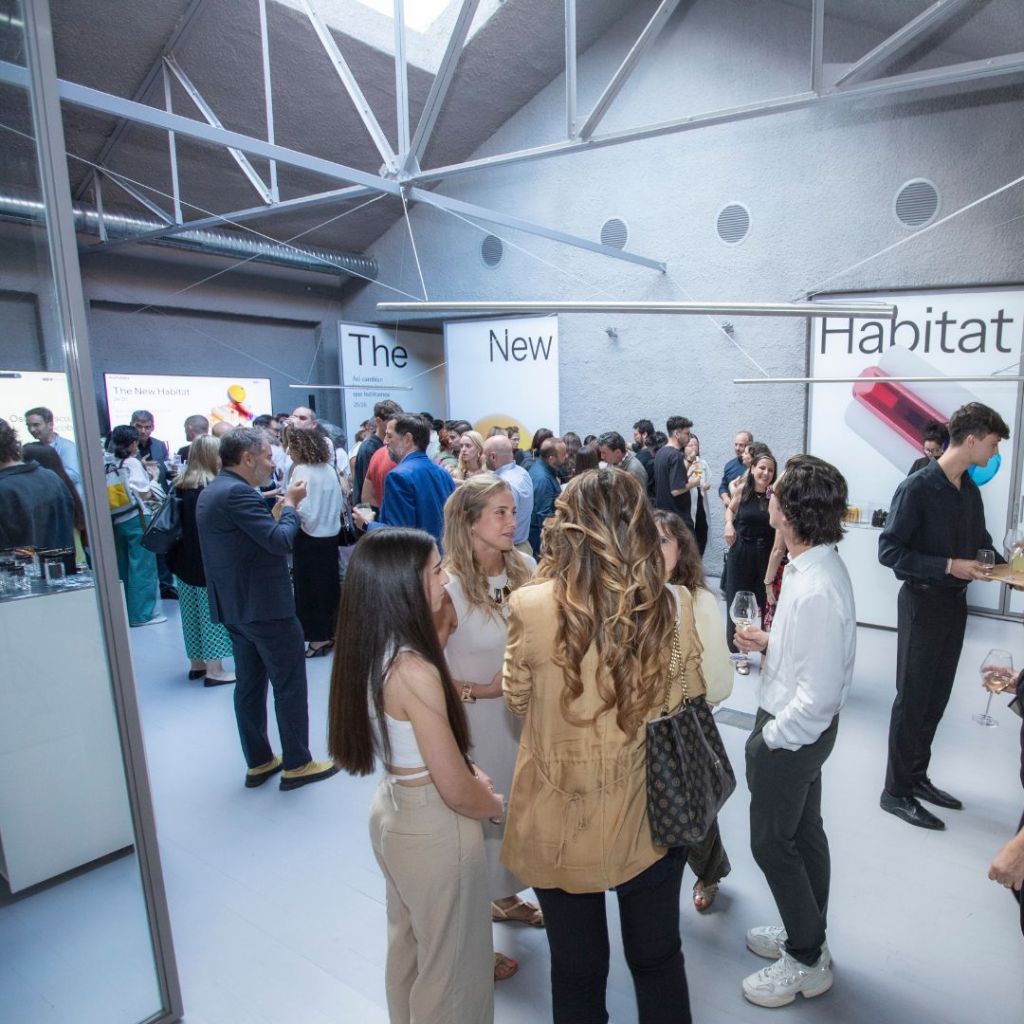

The New Habitat. Image credit: Elisava Madrid
Future-Ready Graduates
Edgar’s innovative approach focuses on developing mindsets rather than merely imparting technical knowledge, aiming to equip students with the skills necessary to navigate real-world challenges.
Success transcends traditional metrics like grades and instead seeks employability as the primary goal. Edgar acknowledges the significance of nurturing a mindset that aligns with the needs of contemporary employers. He advocates for an educational model that fosters critical thinking, adaptability, and creativity, enabling graduates to excel in diverse professional environments.
Shifting from technical skills to mindset development - is vital.
Edgar has designed the curriculum to minimise the emphasis on technical skills, which he believes can be learned independently. Instead, the focus is on cultivating a deep understanding of complex problem-solving and innovative thinking.
Engaging with the Industry
Understanding the importance of aligning education with industry needs, Edgar actively seeks feedback from employers. This engagement ensures that the courses remain relevant and responsive to the dynamic landscape of the design industry. By incorporating employer insights, Edgar strives to produce graduates who are not only technically proficient but also possess the soft skills and strategic thinking required to excel in today's workforce.
Highlighting the evolving role of museums as an example, Edgar spoke of the changing landscape that graduates will enter. Museums are increasingly becoming cultural destinations that offer experiential and memorable experiences. This shift requires a new breed of professionals who can blend historical knowledge with marketing acumen, to create engaging exhibits that attract diverse audiences.
Edgar aims to bridge this gap, preparing students for roles that demand a nuanced understanding of art, audience engagement and good business.
Finding a path that doesn't solely focus on commercial interests is crucial. If left to marketing professionals, they might turn cultural institutions like the Prado Museum into mere shopping centres. However, there is a need for professionals who can balance commercial values with cultural significance. Edgar says with conviction: “Branding is essential for major museums, but it should not overshadow their cultural mission.”
Expanding the Role of Architects and Designers
Edgar would like to see architects expanding their remit in the future. He says one area that needs significant improvement is politics. There's a vast space for architects and designers to contribute. We need professionals who draw from diverse sources and understand their role within a larger, more complex system. Another area where architects can make a substantial impact is in the care industry, including hospitals and elderly care. As our society ages and life expectancy increases, we need to rethink how we design spaces for the elderly.
“We must consider what happens when people retire at 65 but live to 100. This raises questions about the future of work and the role of universal basic income. Architects and designers can speculate and envision these futures, understanding the changes and challenges ahead.”
Technology, particularly AI, will significantly impact every aspect of our lives. As machines take over 80% of current tasks, we will have more free time. The challenge is to find meaningful ways to use this time. It's not just about creating more content for social media; it's about envisioning a future where free time is used productively and creatively.
Embracing a Critical Mindset
Edgar suggests that designers need to adopt a critical mindset to understand the various layers of professional work. This includes user-centred design, business acumen, and the ability to speculate on future trends. By doing so, we can ensure that our contributions are meaningful and impactful in a rapidly changing world.
There's a lot of complacency in the industry, where people don't question the status quo and simply accept: "This is the way it's always been done."
A critical mindset is essential for pushing boundaries and asking difficult questions. Without it, we risk becoming stagnant, merely inventing new things for the sake of novelty.
Although many individuals feel too small to effect change in a big industry, change can start small. “This is where the ability to connect and bring people along with you becomes crucial, ” says Edgar with empathy.
A critical mindset is one of the key elements of innovation. It's not just about inventing; it's about critically assessing and knowing when something is truly good for the user in a given context.
You instil a critical mindset by setting parameters for what is acceptable. To some, design is never truly finished and they will endlessly tweak and refine. But to someone with a critical mindset, they understand that design must end and they seek a desirable outcome.
“Constraints are vital in design. A blank page is the worst enemy of creativity!”
If you want a great example of how constraints can enhance creativity, Edgar suggests you need to see the film: "The Five Obstructions. Lars von Trier challenged his mentor, Jørgen Leth, to remake his short film The Perfect Human five times, each with a different set of constraints. The result was five new films, each arguably better than the original.”
A critical mindset, combined with business consciousness and constraints, creates a powerful framework for innovation. It ensures that we don't just create for the sake of creating but deliver meaningful, impactful designs.
Without constraints, creativity can become aimless.
“You're thinking too architecturally”, Edgar says as I ask: How do you determine if an outcome is good enough or satisfying, especially if it only exists digitally or on paper?"
Interaction with the outcome is key. For instance, one of my proudest achievements is the bachelor programme I developed. It's not a physical structure, but it has a tangible outcome and it is complete. We need to move beyond the idea that realisation must be physical.
Edgar provokes us to consider exhibitions, which are more tangible but still not physical structures. Another example is the Beyond Branding programme one of the ones offered by Elisava Acid House Madrid, which redefines branding beyond traditional manuals. “Think about the Netflix ta-dum sound - it's a powerful branding element that exists purely in the auditory realm. This is an outcome too.”
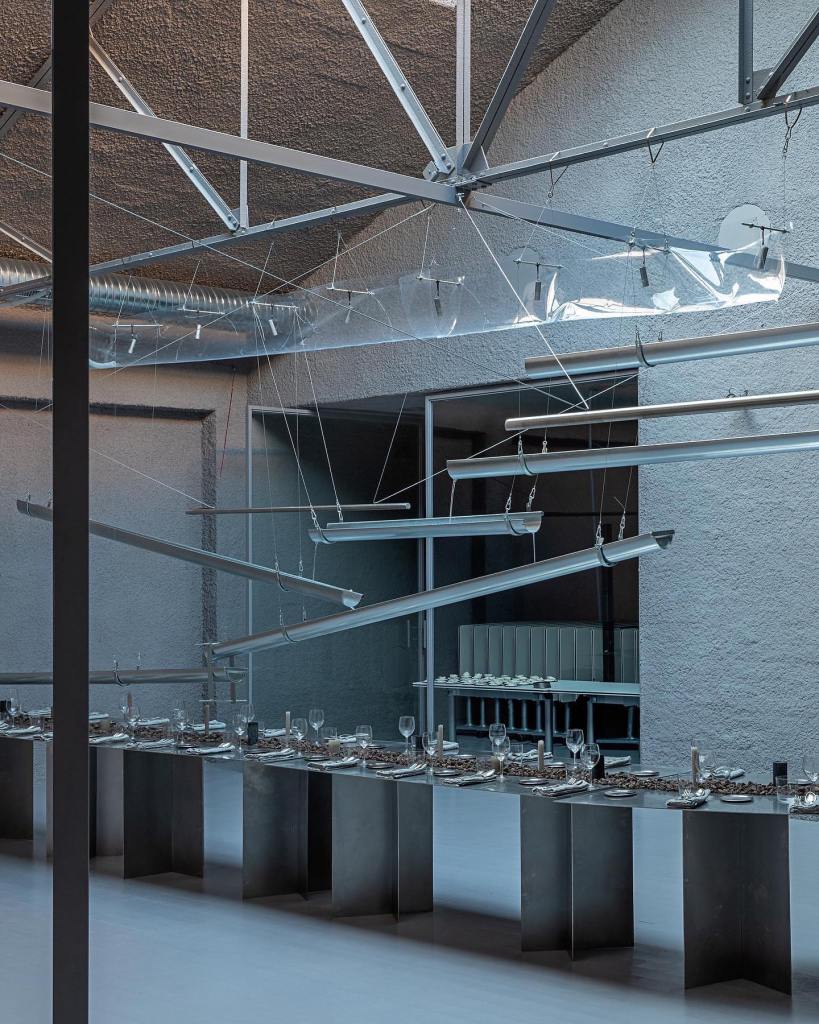




Fondo Supper Club. Image credit: Elisava Madrid
Friction Leading to Innovation
Design education provides a set of tools that are extremely useful when applied outside their traditional context. The big misconception about design thinking is that anyone can become creative overnight with the right prompts. That's not true, Edgar says. Creativity is a developed skill that some people possess, like designers or architects. When you pair a creative individual with an experienced professional, such as a seasoned accountant, the combination can yield innovative results. This friction between two different approaches is where real innovation happens.
“It's about leveraging the strengths of both parties. It's not about one expert solving all problems but about creating an environment where different experts can collide and produce something new. This is the direction we're heading with our current programme. We focus on what toolsets these professionals need to facilitate this kind of collaboration.”
Learning to calculate the deflection of a concrete beam, for example, teaches architects to approach complex problems creatively. While it may never be used directly by an architect on a construction site, the process of solving such problems is invaluable. It’s about developing a mindset that can tackle challenges innovatively.
Another crucial ingredient for innovation - is an entrepreneurial spirit. An ability to see past mundane activities to new opportunities and have faith to keep moving forward.
Key Takeaways
Edgar Gonzalez's visionary approach to design education seeks to empower students with the mindset and skills needed to thrive in a rapidly evolving world. By prioritising a critical mindset over technical training and fostering close ties with the industry, Edgar's programmes are poised to shape the next generation of innovative designers ready to tackle the challenges of the future.
While AI can provide valuable historical insights, Edgar confirms that the human element - the ability to synthesise information and create compelling narratives - remains irreplaceable.
He reminds us of the importance of leveraging technology to enhance learning while focusing on developing the unique human capabilities that AI cannot replicate. His perspective on the need for architects and designers to take on broader roles in societal contexts, such as politics and the care industry, opens new avenues for impactful contributions.
Edgar Gonzalez's vision for disrupting design education is a testament to his training as an architect and his willingness to infuse the system with critical thinking and business acumen. A revolutionary approach that will no doubt produce a significant ripple effect of entrepreneurial designers across a wide variety of industries in the decades to come.