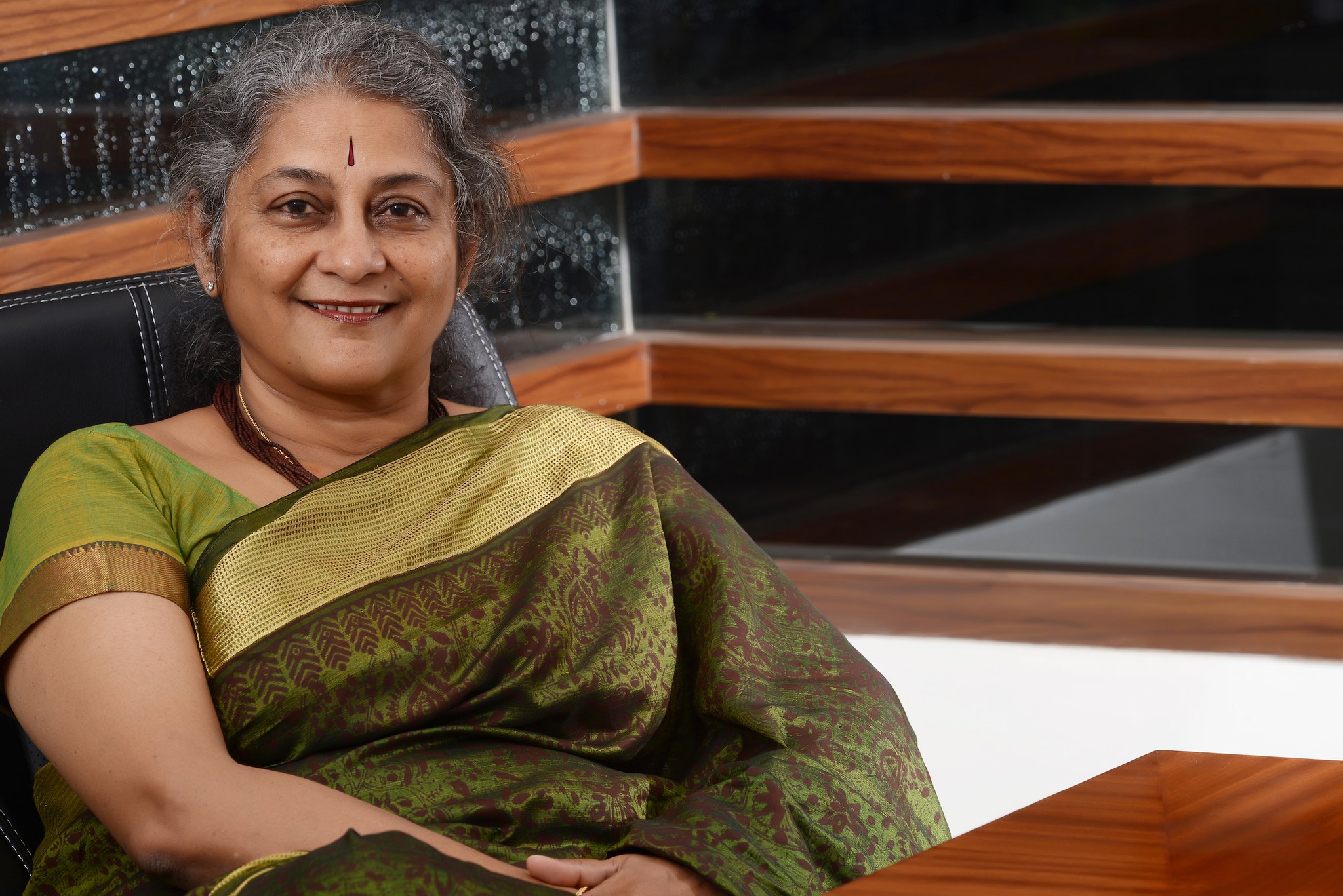
Sheila Sri Prakash is an internationally acclaimed Architect, Urban Designer, and Sustainability Expert, who founded Shilpa Architects Planners Designers in 1979. She formulated the Reciprocal Design Index, in 2013 when she was part of the World Economic Forum Global Agenda Council for Design Innovation to establish, document and incentivize sustainable design of cities. She is widely consulted on matters of urban sustainability by several governments and is closely associated with the Chennai Smart City (board of the SPV), as an Independent Director and Urban Expert. Builders, Architects and Building Materials (BAM), in association with CII Real Estate & Building Technology Exhibition, has conferred upon her Lifetime Achievement Award in the field of Architecture in 2019 for her outstanding achievements and contribution to sustainable design thinking and the growth of Indian real estate sector.
As the first woman in India to establish an architecture office in not only a male-dominated country but also a male-dominated industry, Sheila Sri Prakash set up Shilpa Architects in 1979 almost 44 years ago. Sheila says “It has been a journey, it has been a very tiring journey. I must say tiring and challenging at every point. You have to prove that, you are there to stay because in 1979 there were hardly any women architects. Women would be accepted as interior designers but not as Architects. Just like how women are accepted as gynaecologists and skin specialists but a heart surgeon is a no-no. So that way architecture was predominantly a male bastion”
She starts by saying “So I started working on projects, which were cost-effective because that was what I believed was required in the Indian subcontinent, a developing country”. She researched local vernacular traditions and methods that she could modernise and adapt to her own work. This proved to be an uphill task as she couldn’t get people to execute her designs and therefore trained people herself to execute them. After much experimentation with brick in place of RCC, she used the material to make spaces cooler and more responsive to a hot humid climate which is the microclimate of Chennai. Being a part of the industry for as long as she has, you can define your purpose and create a niche for yourself.
In her experience with working with men, she says “I think I've also had instances when young men did not like to work for a company run by a lady. So that bias is also avoidable now because I think, with all my grey hair I come across as a very senior figure.”
Sheila recalls how people would refuse to pay her fee saying “Why should I pay you? You're doing it as a hobby. I'm doing you a favour” She responds to these comments by saying “And I've heard a lot of people think the same way and even friends not approaching me with their residential projects. Because one guy told me ‘How could I fire a woman? So I'm not giving you the job.” There were also other instances where people doubted her ability when it came to overseas projects or projects that required her to travel, select materials, go on site visits and conduct case studies.
In another instance when her team was shortlisted for a project for a bread factory, a renowned Government of India Enterprise, she was turned down because it was assumed she was ‘only doing it as a hobby’. How does one prove that the hobby is in fact a profession? She believes the only way forward is to keep moving with a strategy and bring your uniqueness into your work.


By this time she started working on climate-responsive architecture, energy-efficient architecture, and cost-effective architecture. In the 1980s before the green movement came into action not many people were aware of sustainable building, which is not the case today.
Yet another defining moment for Sheila was when she was recognized by the University of Hannover as one of the seven women in the world, whose work on sustainability was presented at a touring exhibition from Hannover to Spain, Valencia. This gave her confidence and reassurance that she was going in the right direction. Though her work was not commercial not as successful and not making enough money as her male counterparts she was creating ripples with work of a smaller scale. The World Economic Forum (WEF) invited her to be on their Design Innovation Council where she worked on concepts like incremental houses in which a house slowly becomes a home. With the bare minimum in the beginning, one starts with a roof and then adds on as their finances allow. The last step is to provide facilities that make it a home.
She says “I also started this philosophy of Reciprocal Architecture where we are able to respond not only to budgets but also to resources, capabilities, local arts and local materials. We have excellent craftsmen in India who work with wood, stone and clay and I try to include their work in my architecture. I called it reciprocal because it's not only what they do for us but also what we do for them. So it's a win-win for both”.


She extrapolated this process for cities at the WEF where she included more parameters like health, cleanliness, resources, risk, crime, communication and circulation. The complexity of this increases with the addition of more parameters. She calls it “making sense of the mad chaotic, parameters that are all contradicting each other sometimes”.
All of her past work at the WEF facilitated her invitation to speak at Habitat 3 in Rio. She spoke of cities and the role of their public at a time when cities were a clone of each other.
She says “It's a perception of what the city needs. If you drive around downtown America, you see the same Kroger, Walmart and Taco Bell. One city resembles another and that shouldn't be the case. In any place, the culture, history and values of the people have to shine, working on the strengths of each state”.
Sheila who was speaking to Sara from The Mariott at Raipur at the time of the interview said “The manager asked me to make suggestions for the menu for dinner for tomorrow's Gala so I recommended that the food be authentic to Raipur. I think we should not try to replicate something from somewhere else, but, look within Raipur to see what is best to be included for tomorrow's Gala. So, that's where I come from. I do a lot of soul-searching if you may say so. Search for your strings and then try to respond to them and include them in your design”.
Sheila drives her practice and projects with heart. To her, being an entrepreneur is similar to nurturing a family. This is reflected in her thought - “I always tell women architects that they are special because we are physiologically and psychologically tuned to nurture our families. So we nurture designs the same way with the same passion and focus as we do families and that really shows. There is something different in the design that we do. We also always excel in multitasking. These are two strengths that, women possess and we should use them to the hilt in our profession”


She also worries about the way design is progressing because of the complexity. The team is larger and much like doctors have specialists so do architects. The consultant group is increasing in number with project managers being introduced to the process. Though architects are in charge of the design intent, cost and time we have project managers whose mandates are only cost and time and the focus is lost on design intent, especially for large-scale projects like skyscrapers and townships.
“Unless the architect orchestrates the Orchestra of Consultants it becomes challenging for an outsider to modulate or make music out of the noise. I always say creating music and not just sound is so different”
Sheila Sri Prakash
At the office, Shilpa Architects is involved in a range of projects from individual homes to institutional buildings. She says “The flavour of the season is high-rise towers. In India, 20 meters with 35 to 40 floors is a high-rise. Building vertically is the way to go if we have to cater to the densities as well as have the ground cover that is required to make living comfortable”. Every project is a learning experience and that's what keeps an architect young because everything is new when you start afresh. She adds “It's true for any young architect. It’s the passion and the focus and if you look deep enough you will create a niche for yourself. If you continue to trudge along in that direction, you're sure to succeed”
Technology is not only adapted but also embraced at the firm and used as a tool to enhance output. Speaking of AI she says “When everything becomes standardized it becomes like machine living. If it does then it's not worth creating.”
Sheila Sri Prakash has made a lasting impact on the field of architecture in India and beyond. Her determination and passion have allowed her to overcome obstacles and carve a niche for herself. Throughout her journey, Sheila has been a strong advocate for women in architecture and leadership roles. Her journey emphasizes the importance of maintaining a strong sense of purpose and continually learning and adapting in a rapidly evolving industry.
At the Women’s edition of Disrupt held on March 8th 2023, Sheila spoke about her journey as one of the few women principal architects of her time, starting and leading her firm in India, driving a business with heart and about women in leadership roles.