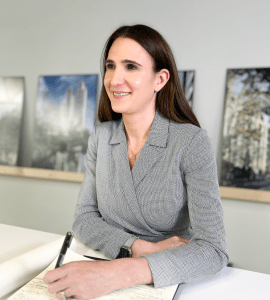
With over two decades of professional experience in architecture and construction, Helen Burke's career path has led her from specialising in project management for corporate real estate clients to her current role as Director of North American Operations at M Moser Associates. Known for her innovative approach, she leads large project teams in creating meaningful and transformative workspaces that meet the unique needs of their clients. Together with her team, she integrates technology to enhance collaboration, working both locally and nationally to deliver top-tier workplace environments.
In addition to her role at M Moser Associates, Helen is an active member of the Dean's Advisory Board at the University of Kansas School of Architecture & Design, where she supports the educational mission through engaged interaction with students, faculty, and the community. Her previous roles include significant positions at IBM Middle East and Africa, Equity Office Properties in Chicago, and various leadership roles at M Moser Associates in Hong Kong and New York.
With a keen interest in art and science, Helen has been immersed in architecture for over three decades. Her journey began when, as a high school student exploring potential majors, she attended various career fairs seeking to balance her dual passions. It was during a summer camp focused on architecture that she found her enthusiasm sparked, prompting her decision to pursue it further at university.
Throughout her career, Helen has encountered unexpected opportunities that have steered her path. Initially following a more conventional route in architecture post-graduation, she soon found herself drawn into international design competitions, which exposed her to project management and leadership dynamics.
Her professional journey has taken her to diverse locations, from Chicago to Hong Kong, to Dubai where she continued to broaden her perspective on global architecture. Helen found herself thriving in roles that bridged cultures and continents, ultimately landing her in New York City where she resides today and where the international character of the city continues to fuel her passion for exploration.

Crafting Architectural Experiences at M Moser
Alongside the collaborative nature of the firm, Helen values the importance of listening and observing to harness the unique insights each team member brings to the table. Recognising the diverse skill sets and attention levels required for each project, she emphasises assembling the right team from the outset.
In the dynamic nature of project management, flexibility is key. Listening attentively to clients' needs and objectives is paramount, ensuring that the design aligns with both their business goals and the well-being of the people. For Helen, the essence of M Moser’s work lies in creating meaningful workplace environments that prioritise the human experience.
Nurturing Client Relationships
Valuable and enduring relationships in architecture stem from repeat work. Once a client or account is secured, nurturing that relationship is essential. By attentively addressing needs and facilitating a conducive business environment for employees, further opportunities naturally unfold.
As a global entity with an expanding presence across numerous locations, M Moser has established itself as a trusted partner in the architectural and design landscape. The organisation adopts a distinctive approach - rather than compartmentalising operations or working in silos, they leverage collaboration across its various disciplines and global office locations. This holistic approach has been instrumental in both client satisfaction and the rapid growth and success of the organisation.
Placing a premium on integrated services and client collaboration throughout the process, Helen involves clients at every stage, seeking their input and feedback to ensure alignment and transparency. Instead of working in isolation and presenting finished products in a vacuum, there is ongoing dialogue and iteration. This continuous engagement allows clients to feel heard and valued, nurturing an environment where they feel comfortable providing transparent feedback and suggestions for improvement.

Designing Beyond Trends: A Holistic Approach
Helen reiterates that M Moser’s work, rather than prescriptive, takes a bespoke approach tailored to meet the specific needs of the client, their employees and their business goals.
The firm draws on experiences and information gathered from more than 40 years of experience along with its global suite of Living Labs, the title given to its offices where they test and trial new ideas before bringing them to life. These Living Labs bring clients, thought leaders, researchers and industry professionals together to exchange ideas, challenge perspectives and push boundaries.
By analysing data and exploring new integrations and spatial designs, M Moser elevates the workplace experience, shapes new behaviours and creates a sense of belonging. In doing so, the firm is able to tackle the most significant challenges facing today’s workplaces.
Helen notes that alongside wellness, there is an even greater shift towards sustainability happening across the industry. This shift requires a more holistic approach to sustainability, moving beyond material specifications to consider the broader environmental impact and human interaction within spaces.
Rather than focusing solely on cause and effect, the industry is embracing a more comprehensive perspective that prioritises the well-being of both occupants and the environment.
Technology and Perspective on Innovation
Technology has the capacity to enhance efficiency without overshadowing the creativity of design teams. While technology undoubtedly offers sophisticated tools, Helen believes it has a supportive rather than substitutive role and is an irreplaceable contribution to human ingenuity.
Genuine engagement, although through technology, enables productive exchanges even in virtual settings. For example, with tools for project management, users can optimise their time while still capturing meaningful conversations, thus enhancing collaboration and rapport-building. By leveraging such tools, individuals can focus on aspects that truly contribute to the desired outcome, such as fostering mutual understanding and gathering valuable feedback.


Charting a Career Path with Openness
Helen navigates professional aspirations with an open mind. She acknowledges the value of meaningful contribution over predetermined career milestones, emphasising the importance of flexibility in one's approach. Her advice to aspiring professionals is to remain receptive to unexpected opportunities, even if they diverge from their initial career trajectory. Drawing from her own experience, she emphasises the significance of humility and curiosity in seeking growth and learning.
Encouraging a curious approach, continuous learning is inherent in architecture and design and it is important to have new experiences and enjoy the process. Curiosity, above all, remains a driving force for Helen.
Cultural Communication and International Collaboration
Diverse backgrounds and experiences enrich projects significantly and reflect Helen’s open-minded approach. Having lived and practised architecture abroad, her exposure to a wide array of problem-solving methods has given her deeper knowledge of cultural nuances within design. In particular, local expertise ensures that design solutions effectively address regional needs. While global knowledge offers a broader perspective, local insights are essential for tailoring solutions to specific regions and contexts.
Seeking guidance from colleagues and immersing oneself in local practices helps better understand cultural nuances. In her role covering the Middle East and Africa, Helen encountered diverse cultural landscapes, each requiring a nuanced approach and a necessity of thorough research when navigating unfamiliar cultural terrain. Communication, even when challenging, is key she concludes, especially in regions with richly diverse cultural tapestries.

Vision for Workplace Design
Creativity and innovation are values each team member at M Moser brings to the table. Given the significant amount of time people spend at work, it’s a necessity to create environments that promote well-being and a sense of belonging while supporting productivity.
M Moser is committed to guiding clients toward unlocking the full potential of their built environments. Through the use of its Living Labs, experimentation, continual learning, iteration and adaptation, M Moser will continue to test new concepts and technologies before bringing them to life in client projects.
Today, there's a noticeable surge in the need for adaptable workspaces. Experimentation within more adaptive settings allows for swift spatial reconfigurations sans hefty construction expenses. Adaptive setups also offer flexibility and ease during transitional phases.
While remote work offers benefits like flexibility and focused productivity, the importance of in-person collaboration remains paramount. Given the spontaneity and creativity fostered through face-to-face interactions, there is irreplaceable value in shared physical spaces and the sense of community that an in-office experience holds.
The Future
Helen’s three-decade-long career in architecture has been a harmonious blend of art and science, fueled by her passion for creativity and continuous learning.
Ahead, Helen envisions even greater flexibility and adaptability in workspace design. Spaces that can be easily reimagined and repurposed to accommodate evolving needs and preferences – a vision further propelled by technological advancements and a deeper understanding of collaborative workflows.
With technology enhancing the creative process and innovative design solutions furthered, Helen hopes that curiosity, adaptability and a respect for both people and the planet will serve as inspiration for future architects and designers.