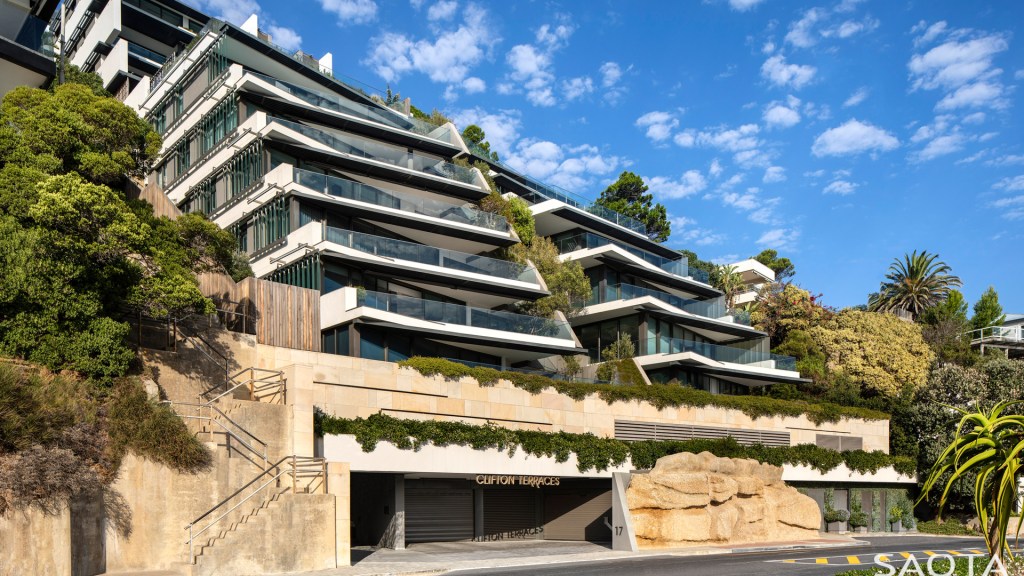
We interviewed SAOTA, a leading architecture firm whose innovation and dedicated approach to the design, documentation and execution of projects globally, has made it an internationally sought-after brand from South Africa’s scenic Cape Town.
Driven by the dynamic combination of Stefan Antoni, Philip Olmesdahl, Greg Truen, Phillippe Fouché, Mark Bullivant, Roxanne Kaye and Logen Gordon, who share a potent vision easily distinguished in their practices, SAOTA has a global footprint with projects on six continents. Their focus on achieving maximum value has also led to invitations to design, build and create highly prestigious projects. Increased exposure to the global marketplace has seen SAOTA flourish as cities and contexts allow for infinite inspiration which can be seen radiating from the approach to design.
Their design philosophy bridges function and form, and is in pursuit of true architectural design to create solutions. They clearly understand the place of design in the world and how to deliver architectural projects in diverse markets. Their spirit guides the firm which maintains its position in a highly competitive and fast-changing industry.
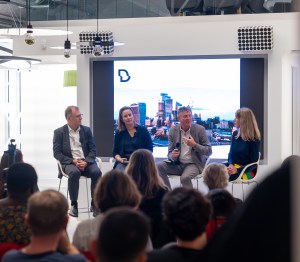
SAOTA has been a constant supporter and participant at the Disrupt Symposium. Sara Kolata interviews Principal Stefan Antoni along with members of his marketing team Celeste Botha and Kristy Robinson.
Tackling projects in new geographies, the impact of SAOTA in South Africa, and a new entrepreneurial perspective
Started in 1986 with 7 principals and based in Cape Town SAOTA is a team of around 360 people. The majority of their projects - 95% of them - are based outside of South Africa and only 5% of them are in the country. This, Stefan says, was a result of the transition that was not orchestrated by the team but one that happened organically. The shift made sense as the world markets crashed in 2008 when their projects were on hold and some projects overseas even completely stopped.
After a two-week hiatus, people from all over the world reached out to the bottom end of South Africa to the firm for projects. Clients immediately garnered a huge amount of interest which also coincided with the team creating strong marketing content for their digital space. Much before the AEC industry understood the power of social media SAOTA had been focusing on their social media and communication strategy. This was a boom for them and created interest for the firm around the globe acting as a testimony to the efforts in communications, business and client acquisitions. At a time of quiet, a sector of the market developed interest not just in pursuing architecture but in pursuing architecture with SAOTA.
We at Disrupt try to keep that in mind, as architects still underestimate the impact social media and communications have on a business. Often times the mistake is that practices only try to advertise in places that are not massively accessed by clients.
Commercial work in South Africa is exactly that. Commercial. It is also highly developer-driven which is why the firm chooses to execute projects outside the country. SAOTA has ongoing projects in 86 countries and around 140 cities with video calling driving them. Engaging with clients, looking after them and making them the firm’s best ambassadors are largely responsible for their success. Word of mouth and clients’ and project managers’ raving reviews of the firm have been a major reason for them winning various project commissions. Their reviews almost always sound like - “it’s a pleasure dealing with them”, “they’re always there for you and you can always count on them to enthusiastically solve a problem”, “they give back more than what’s expected” and “try them out”. This is one of the major ways their network grows which has led them to be architects for 35 projects in LA alone making them a household name in the city in the past 6 years.


It has also helped them rub shoulders with big names in the industry and be selected for prestigious projects where they were considered over and above local firms. At every location, they try to understand the culture, look at areas objectively and embody the speciality of the place. Not appreciating what we have at home may lead us off-direction. For this reason, while some designers look outside for inspiration, the practice tries to hone in on what makes the location unique and use that to inform their design choices making the structure unique to the place itself.
The firm is mainly based in Cape Town and over the last two years the staff have found their homes wherever they want to work. Some went back to their homes in the cities in South Africa and others went back home overseas to their families. With a positive nod from the principals, only 25 per cent of the team members visit the office in Capetown.
Stefan himself worked from Clifton Beach during the time of the interview and went on to talk about the benefits that we got out of the pandemic. Clients and more so businesses have become relaxed with regard to where they have staffed as long as communication bridges the gaps. He also goes on to show concern for the younger people joining the business and missing out on the culture and incredible energy of an office environment.
While speaking of architects of record - “We put a lot of focus on our architects of record. The architects of record’s fees are much higher as design architects only work for a limited period of time with a watching brief. Architects of Record on the other hand have to make construction drawings and oversee the construction over a lengthy period of time which is hard work and difficult work. We build a very good rapport with architects of record and look after them. We need them and don’t want to change them as they have a good understanding. We then fine-tune and implement it from project to project.”


The practice has always been very questioning in everything they do while also being highly efficient. “How we could do it better, quicker, with fewer hassles and fewer complications” is the question they want to solve during projects and do so by building on what they’ve done before. Referencing a comic he says - “ never write the same letter twice. Write it the second time, improving on the first one and the third time improving on the second and save all of it. So that it hasn’t been thrown away but has been used by someone else to learn from.” This ideology pushes them to question it in relation to the system that they’ve set up making it the core of their business.
Drawing a picture of what it was like 35 years ago Stefan says - “When we made presentations it was all manual and time intensive and I remember timing it and leaving 2 hours before for a client meeting to quickly draw sketches and 3D perspectives of the project using markers. And as the clients walked through the door we looked nervously at the ink still drying and all our fingers covered in it. But today tech has opened the door for everyone leaving nobody with excuses”.
Some of the most incredible buildings in the world were built before VR and the fact that architects had such incredible spatial vision is beyond staggering. It’s surprising to see how people are not adapting to new technology like virtual reality because in a field that is so visual, of course, you want to see something as a whole and as real as you possibly can before you build it, work up construction details or even design it. With how times have changed being equipped with technology only works to our advantage.
Celeste from SAOTA’s marketing team adds - “We’re about 300 people and 7 principals in the studio but we are 3 brands - the architecture side, art, and furniture design and they look over different regions globally. What can happen if you don’t have proper systems in place is it can easily become 7 studios without one design DNA. Having these ideas in place and cross-communication helps because otherwise it could easily be siloed operations.”


Principles, essential objectives, and systems for efficiency
Mistakes cost time and damage the reputation of a practice. Learning from them and absolutely avoiding them is the key to efficiency. Efficiency also takes centre stage because fees are always being squeezed and you have to run profitability. If construction takes too long and certain people struggle without assistance then there is no proper system. When you make mistakes you have to make time to evaluate what you have done.
To combat these issues the team has weekly finance meetings with a full report that is very architectural and visual on everything including where it is in the process, how many people work on it etc. Every project is viable at any point in time. Stefan thinks back saying “When I was dealing with accounts I saw that accountants can think in abstract and in numbers but we can’t. We think in forms and shapes so our financial documents are very visual and colourful. Which means that I would read it totally differently than an accountant would read it. It sounds strange but that’s the way one can tailor for your strengths and weaknesses. Systems only give us a start and help us work in the most synced way possible”.
Every Tuesday they have fairly formal meetings that go from zone to zone covering finance, systems, production, practice and process. Led by the directors until 3 years ago, the team realised that incredible people in the upper half of the office were overlaid by administrative responsibilities, finetuning and systems. By breaking it up into smaller departments and assigning heads and support teams all aspects of a certain kind of work and refinement are introduced to respective teams. Work is then delegated after which a senior checks on it. Sometimes a discussion is spread out over 2-3 weeks.


This way everybody works cohesively in their role and their contribution is reported as progress in a Tuesday meeting. The aims and goals discussed for the next six months also take up a chunk of the meetings. After a certain point, a company must change how it operates and so must the team. Bringing someone from the outside that is not intimate enough will have to understand operations from scratch. Rather people who are living and working with the issues must question systems as well as design decisions to improve them.
There are people that are great thinkers and doers and there are others that are just doers but you realise you need the thinker to play a role. The principals promote the people who question the way they do things, make a difference and prove themselves under SAOTA’s standards. Allowing people to also step up and listen to them is extremely important. Generally, in a traditional system of an architecture firm, this was not encouraged but as we move into newer ways of working, practices are adopting a non-hierarchical system for people to step into their own power. To retain good people we have to give them ownership and get them to not treat it as a 9-5 job. The work is now their contribution and they are making a difference by influencing society, the office and everyone around them.
SAOTA reinforces this non-hierarchical system by encouraging it very early on in the project. Rather than a senior imposing their ideas they are given a brief to work on and come back with ideas which are further explored in case of a positive outcome. Other ideas are used at a time that is more feasible to the theme of the project as they too hold value. The fact that they ventured will teach them something from the experience and they will know what they were looking for in the first place. Stefan says one of the most thrilling things is seeing young people suddenly blossom. But the biggest frustration is seeing someone underachieve and live down to their potential.
The team also brainstorms ideas in RAD sessions also known as Research Analysed Design. A group of 5 team members led by a principal director assigned to a region in the world present their project. These meetings are robust and at every session, the improvement in design is phenomenal as they rejuvenate throughout the week. The end result is that teams come out with flying colours.


Architects sometimes are precious. In that, they think that talking about business and money is almost wrong. We are expected to be struggling artists. But topics like this have to be spoken about in order to make them real. Design is a huge part of our work but there are other aspects that are as important. Business gives you an opportunity to be creative.
The marketing efforts of the team, a humble group of 10, are now also extending to a more formal Business Development Wing. Celeste says “Even at 40 years old it still feels like a startup sometimes”. She adds “There is always like ooh we maybe need a proper system or a process there. So let's start these extra units or start cutting back. It's like, you know what you want to do, but you have to make some mistakes along the way. It’s really crazy to see just in the last five years, how we've expanded in terms of roles and responsibilities because I think we are still not doing 50% of the stuff we are supposed to do, but it's just about finding the right people to do it and also knowing if it's a brand fit you like”.
Developing a business with its own character and giving it a personality that reflects the business heads’ is what makes it unique.
On being transparent and having open conversations about business, Celeste says - “We had a conversation with another architecture firm in 2021. There was no purpose of the meeting, other than to understand how they work internally how the partner's structure works, how they cover different regions if they have a marketing team and do they have a business development. But it was just a conversation and we picked up a lot of clues that we can implement. And so did they. So I think it's very important to openly talk about things like this”.


Brand message and communication principles
Communication with different clients and markets is tricky. For example, how they communicate to their European clients or a European database, or how they set up meetings and do business in Southeast Asia or the Middle East is completely different not only in terms of how they speak in face-to-face meetings but also, in the documents and communication tone online. And so is the case from a design point of view. Keeping calm and consistent in inconsistent contexts globally is risky.
Once you have a clear idea of what you stand for as a design firm winning clients through problem-solving will help you attend to their needs. Winning a client's confidence when they are considering you will establish that you have a good presence in the fact that you have built a lot of buildings, published them and have a great website and social media, reassuring them that they are in good hands. Once clients are convinced with your portfolio their next question will be “Do you understand what I'm looking for as a client?”
Stefan says “We always ask a client to look at our website and give us feedback. And we think it's a very positive thing because straight away we can read a client so much better. And for me, that's probably been one of my focuses over the years. And now, I think it's instilled in the office”. Ask the right questions. Listen and look at the client when you talk to read body language. He reflects back on a time when in the middle of a presentation, it turned a totally different direction and he had to assess the project because he could feel the client didn't like where it was going but he was quick on his feet to realise that it was not lost. “But the good thing about this presentation is we really know what you don't want,” he said and the accidents now look positive. These kinds of soft skills are important to have and a lot of architects struggle with that because clients can be very demanding in their lifestyle. For their needs to be met and at the same time for us to use architectural elements and principles in the design means to meet in the middle. For experiential reasons finding balance is imperative in making a space highly livable.


The interface between inside and outside is important and varies across geographies too. For European projects in Germany, Austria or Switzerland it’s only sunny for a few months a year. And if during those months you could be living in an elegant zone between inside and outside and not just in a box with a pane of glass, those few months are going to make the year. A lot of people from Europe hibernate when they work and disappear to South Africa, to spend South African summers and then get back for the European summers. “You know that cliché - you measure your life by how many good Summers you’ve had? You need maybe two good summer months a year and that year is a good year,” says Stefan to Sara who was at the time interviewing him from sunny Colombia.
For SAOTA it's about living in a building and being emotionally connected to the building that elevates your life. It is the most important aspect of what they do as they strive to do well because there comes wisdom and understanding of the many aspects throughout the process. Even though the buildings appear strong the architecture has a presence. They are interested in creating spaces where you enjoy the evening under the pergola with sightly creepers and vines. Spaces where one can lounge around a fire while sipping on exquisite wine and delectable food with just the right lighting and mood are immaculately conceptualised. “The sound of water in your ears with beautiful smiles from the people in the garden that's the poetry of life and I think a lot of it depends on where you fit into the architectural world because I think for us it's a combination of things and if we can get all the aspects into our work together, then we've done something very special. And that maybe is going to be the strongest architectural solution, always. But it's a journey and there’s a long way still ahead because there's still so much to learn. ” says Stefan.
While speaking of the Disrupt Symposium Stefan only had positive things to say. “I think what you're doing is fantastic and I think you've given it a slightly different angle which I must give you credit for. In fact, that's why we were even attracted to it from the beginning because even the name Disrupt sounded interesting. Picasso said - every act of creation begins with the act of destruction, you’ve got to rip it apart, question it and you’ve got to put it back and rethink it in a new way and I think that's what you've been trying to do and I think you've done it very successfully. I'm amazed in the short span of time, you have made a very big impression, so well done and you can be very proud of yourself and your team.”