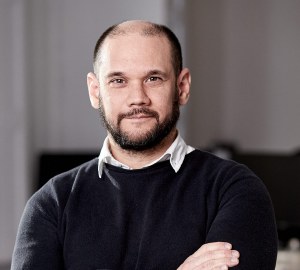
Myles Cummings, an accomplished architect and senior design lecturer at Birmingham City University, in charge of the foundation in Architecture and Design course, embarked on a journey that weaves through diverse career paths and continents. After graduating from Manchester Metropolitan University, he worked in several large commercial architecture practices before deciding to travel through Asia and Australasia. His travels helped him explore various career options beyond architecture such as computer animation and film. Upon returning to the UK, he completed his Architecture education at Manchester and established a practice. He was then invited to teach computer animation part-time at his alma mater and Salford University.
Eventually, he left to pursue roles as a 3D animation producer in Germany and London and returned to the UK to set up the country's first 3D Animation Diploma course. He joined Greenwich University to head the new 3D Digital design/animation course for 7 years before continuing to take up teaching roles in Dubai, India, and Malaysia and finally returning to the UK to take up his present role in 2018. He has been a freelance architect, designer, photographer, and videographer for the majority of his academic career and his most recent obsession with drones and drone photography has enabled him to become a certified drone pilot.
Myles joined Sara Kolata at Arch Talk: Tank podcast to shed light on his experiences in varied career paths and the evolving design landscape.

Early Career Story
Myles’ journey started as an engineer. “It was an awful lot of maths and a combination of electronics and mechanical engineering,” he says. During his university days, Myles shared his living space with a flatmate who was a product designer. It was during this time that Myles developed a keen interest in the intricacies of design and the art of drawing. He spent a term in engineering, before going with his gut and transferring to architecture.
After his architecture degree and practical training, he stepped out to explore Turkey, Asia and Australia. There, he developed a keen interest in areas beyond architecture such as film and computer animation. Myles took an evening animation course at Hanna-Barbera Studio, which eventually helped him land animation jobs. He was so intrigued and fascinated by the animation sector that he considered taking it up as a full-time career option. He even enrolled on a few courses in the field, but life had other plans in store for Myles.
After coming back to the UK, Myles and his colleagues set up their architecture practice. Though times were marked by recession and scarcity of architecture jobs in the 90s, every cloud has a silver lining. Myles and his colleagues then focused on competitions and creative projects and even received sponsorship for them.
Myles's love for film and multimedia continued to grow, leading to projects involving film production and multimedia work. Myles’ diversified skillset opened a plethora of opportunities for him and helped him land a well-paying job in Germany with a multimedia company, where he contributed to Germany’s first-ever CD-ROM production. His work involved creating virtual 3D designs, allowing his imagination to take flight, without being constrained by real-world regulations and structural considerations.
In a surprising turn of events, Myles also ventured into teaching. Initially, on a part-time basis, teaching allowed him to share his knowledge and passion with others, adding yet another dimension to his career. Eventually, the choice between architecture and multimedia became unavoidable. Myles then decided to explore various opportunities in different places around Birmingham, where he continues to apply his diverse skill set and experiences to this day.

Architecture, Engineering and Travel
Myles found architecture a better fit for his interests and skills after transferring from engineering. Walking into an architecture studio in Manchester, he immediately felt a sense of belonging, a sense of familiarity and comfort. The creative and artistic feel of the studio reminded him of his art school days at college. His emotional connection with architecture led him to trust his instincts and opt for a career in the field, where he could fully utilise his talents without the burden of extensive mathematics.
His love for architecture led him to travel to multiple locations. According to Myles, “Travels help expand your vision. With architecture specifically, to see how architecture is in other places and the way of thinking about buildings as well as how people and different cultures interact with buildings.” Myles recalls his interactive discussions on iconic buildings in his lecture studios and how his experiences have shaped his teachings as well. During his travels in Europe, one of Myles’s preferred activities was picking out a cosy cafe and taking a seat in a corner to relax while he loved to capture the moments with his camera. After shooting small films, he would develop them, and send them to his parents, to share his journey and replay all the places he was visiting. Upon returning to the UK, he meticulously put the small clips together created short time-lapse videos and shared them with the world.
This is why, especially in the early stages of studying architecture, it is crucial to keep an open mind and get inspiration from different sources, like art. Cummins’ experience teaches us how travelling allows you to create memories, learn how people use buildings in unexpected ways and also opens your mind to different uses of architecture education.

Architecture Education and Diversity
Birmingham City University offers four design discipline courses that reflect the growing trend that is interdisciplinary and diversified learning. This diversity of options is important for students to explore their creative interests without limitation. It provides them with a clear understanding of the wide range of career possibilities in design and architecture, beyond the traditional path. The central foundation design course that Myles is a part of exposes students to various design disciplines where they initially enter the course to pursue architecture, but also explore areas like interiors, products, landscapes or furniture.
The education pattern of Birmingham University resonates with the evolving nature of the field. It is essential to emphasise to students that diversifying their skills doesn’t equate to failure. Much like not being a licenced architect is not a failure. Other creative fields have less defined boundaries and it is high time we embrace it as a sign of success. Architects who are not chartered have scope within and outside of architecture and must also look towards building success without feeling hindered. Expertise in one area can lead to a fulfilling career, even if it doesn't follow the traditional path of becoming an architect.
While the allure of becoming an architect sounds prestigious, it is important to recognise the transitions happening in architecture. Traditional rules are shifting, creating room for alternative approaches to practising architecture and varied disciplines. Myles shares how the whole structure of the registration of architects is under transition in the UK. Organisations such as RIBA(Royal Institute of British Architects) and ARB (Architects Registration Board) have embraced the reformation and are acknowledging the need for diversity. It is perfectly acceptable to not strictly adhere to the traditional path, especially in the age of the internet, which has opened opportunities for a range of practices. Students should be encouraged to understand that there isn't a single "correct" way to pursue a career in architecture and design. They can explore different avenues, expand their skill set, and chart their distinctive course within the creative realm.

Drones
Talking about his drone ventures, Myles shares how upon his return to Birmingham, people were interested in his drone flying hobby. The city perspective and bird's-eye view have added a new dimension to Myles’s understanding of cities; even places that might not seem so great from ground level can look spectacular from up above. Myles correlates drones with architectural rendering.
“You can make something look amazing in a rendering, but it's a different story in reality,” says Myles.
Myles's observation teaches us to consider not just how architecture looks but how it affects people and functions in the real world. As a closing thought, he also suggests that every architect read the book Neuromancer by William Gibson which is a science fiction novel.
In conclusion, Myles Cummings' journey is a beacon of inspiration for architects and designers to step out of their comfort zones, embrace diversity in all its forms, and pioneer innovative approaches. It reminds us that the world of architecture and design is a canvas waiting to be filled with unique stories, perspectives, and creations. Architecture now needs to involve, accept and embrace related fields and domains to sustain and go through evolution organically without considering people who choose these off-beat paths as failures. Because, as these professionals explore new horizons and forge uncharted paths, they contribute to the ever-evolving and enriching built environment. One that brings development and success to the new world of architecture.