
Nirva Fereshetian, Principal and Chief Information Officer at CBT Architects carved a unique path that bridges these traditionally separate fields. With over two decades of experience, she integrates technology with architectural practice. Her role not only encompasses overseeing CBT's Digital Design Practice Group but also shaping the firm's strategic direction by leveraging technology to enhance design innovation and operational efficiency.
Nirva's journey began with a Bachelor of Science in Architecture from Catholic University, where she developed a keen interest in digital tools. This passion led her to pursue a Master of Architecture at UCLA with concentration in Computation, a pivotal experience where she honed her skills under renowned industry pioneers. Since joining CBT Architects, Nirva has been instrumental in transforming the firm's technological landscape, from pioneering CAD and then BIM implementation to spearheading advanced digital strategies that push the boundaries of architectural design.


Nirva's architectural journey began with her undergraduate studies in architecture, where she developed a strong interest in the emerging digital tools and concepts within the industry. Supplementing her architecture coursework with a couple of computer science classes further fueled her enthusiasm for technology.
After graduation, Nirva spent a year in a traditional office setting, where all drafting was done manually with pen and pencil. This experience motivated her to seek out architecture programs that integrated computing, particularly CAD (computer-aided design). Her search led her to a master’s program at UCLA, where she studied under prominent professors like Bill Mitchell, Chuck Eastman, Goerge Stiny, and Terry Knight. These educators were pioneers in innovative architectural thought processes, including rule-based AI systems, object-oriented design, and BIM.
The two-year master’s program provided Nirva with invaluable experience, including a stint at the LA office of Skidmore Owings and Merrill’s (SOM). During this time, SOM was collaborating with IBM to develop “Draft” software for their workstations, a groundbreaking initiative when digital tools were not as widespread as they are today. This exposure deepened her interest in integrating technology into creative environments.
Nirva's career then took her to Boston, where she joined an architectural firm that understood the importance of technology but lacked a dedicated technology department. She spearheaded the digitization of their manual processes, implementing CAD tools and overseeing transitions like the introduction of plotters for printing, rendering tools, intranet. As technology evolved, so did her responsibilities, eventually encompassing various business technology practices, including security, email and collaboration systems.
Despite not initially intending to pursue a career in Technology, Nirva adapted and learned on the job, taking on more responsibilities as technology advanced. In a firm of their size, she became the go-to person for these tasks, continually evolving her role. Over time, technology became integral to the firm's operations, transforming from a backend support function to a core aspect of their practice. Today, CBT Architects has a “Digital Practice," with technology integrated into all practice areas to enhance processes and introduce new tools for both design and operations.


Evolving Role of the CIO in Architecture and Engineering
The role of a Chief Information Officer (CIO) has evolved significantly, transitioning from overseeing and managing all aspects of business technology to partnering with the rest of the firm in technology use, innovation, and process improvement—what is commonly referred to as digital transformation. Initially, this transformation involved converting analogue processes to digital formats without altering problem-solving approaches or end results. For example, documents were sent as PDFs instead of paper sheets, but the fundamental methods and outcomes remained unchanged.
In the early phases, the focus shifted from 2D line work coordination to building 3D models. Despite this shift, the output continued to be a set of drawings, now in digital PDF format, and only recently has the industry begun submitting and collaborating using 3D models. This evolution, spanning over the last 20 years, highlights the slow but steady progress in transforming processes and mindsets. For instance, utilizing 3D models can reveal clash coordination issues before construction begins, reducing conflicts and requests for information (RFIs) during the construction phase. However, achieving this requires a fundamental rethinking of processes and solutions including contractual agreements designed decades ago.
A significant challenge in this transformation is the generational gap in the workplace. Experienced industry professionals may not be adept with digital tools, while younger employees excel in digital aspects but lack industry knowledge. Balancing and mitigating this gap is a key responsibility of the CIO. To address this, the team recently added a knowledge manager to promote contextual learning and help everyone progress at their own pace.
Introducing new tools and creating new processes is just one part of the equation. Ensuring widespread use and understanding of these tools involves a collaborative system. Tools alone do not define success; it is how teams utilize these tools to generate ideas and solve problems that matter. It is essential to understand the business workflow, including typologies, employees’ skills, client types, contractual agreements. Over the past decade, the emphasis has shifted from focusing solely on tools to fostering collaboration and hiring people who can bridge the gap between digital proficiency and industry knowledge.


Embracing Technology
Early on, building information modelling (BIM) marked a significant milestone for Nirva and her team, becoming a cornerstone in their approach. However, it wasn't until a recession hit that the adoption of BIM gained momentum, highlighting its potential in streamlining processes and enhancing project efficiencies.
In addition to advancing BIM, Nirva has been a driving force behind the integration of collaborative tools aimed at improving communication within the team and with clients. The COVID-19 pandemic presented new challenges, particularly in navigating hybrid work conditions. It accelerated the adoption of technologies that had previously struggled to gain traction, as remote work became the norm rather than the exception. That led to adoption and continuous experimentation of communication tools that acknowledge the realities of a hybrid workforce and enhance the employee experience.
Looking ahead, the focus has shifted towards the transformative potential of data analytics and AI tools within their practice. The rapid pace of technological change poses ongoing challenges, not only in deploying these tools effectively but also in training staff to leverage them to their full potential.
Over the past 15 years, alongside digitizing their drawing processes, Nirva's team has diversified their service offerings and integrated additional tools and methodologies. Sustainability has emerged as a key focus, supported by tools for running shadow studies, daylight analysis, and life cycle assessments. These tools are integral to their design process, providing insights that were previously time-consuming to obtain.
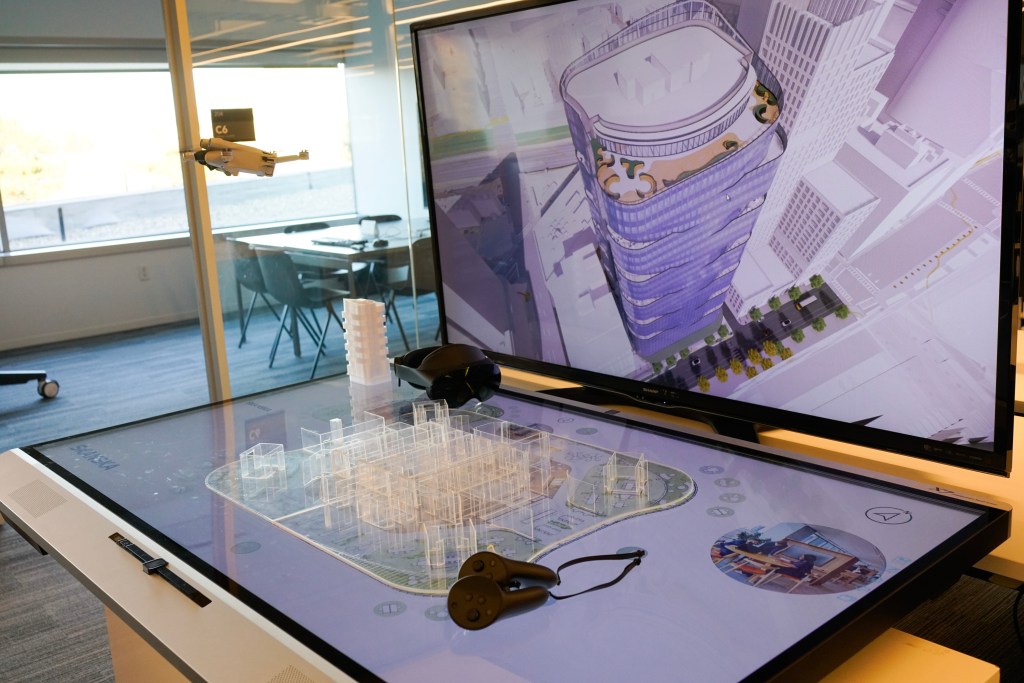
Virtual and Augmented reality (VR/AR) technologies have also played a pivotal role in enhancing client engagement and project visualization. Nirva's office boasts a dedicated media room where clients can experience immersive projections of their designs on a large scale, offering a unique perspective compared to traditional small-screen presentations. Touchscreens and digital screens further facilitate interactive exploration of design alternatives, catering to diverse client preferences.
Balancing digital innovations with traditional approaches, Nirva's team maintains a Makerspace area and model shop that collaborates seamlessly with digital modelling tools. This combination allows for dynamic exploration of design concepts, blending physical models with digital overlays to enrich the visualisation process.


Collaboration for Human-Centered Technology Integration
In Nirva's view, effective collaboration hinges on communication, collaboration itself, and empathy—three pillars she is deeply passionate about. Over the years, she has come to prioritize human interaction over technological advancements, even amidst the rapid changes driven by AI. For Nirva, nurturing human connections and teamwork remains paramount, requiring continuous improvement.
There is a clear need for enhanced training and development in collaborative skills, addressing a gap in traditional education that often focuses solely on architecture or technology without enough emphasis on effective team collaboration and communication. Active listening and aligning interpretations during meetings are critical aspects of cohesive teamwork.
Technological team members should understand the broader business context by participating in sessions that expose them to project goals and challenges. This integration fosters open communication and ensures alignment between technological solutions and business objectives.


Navigating a Male-Dominated Terrain: Women in Technology
In both architecture and technology, Nirva acknowledges the historical dominance of men, particularly evident in her earlier career experiences. She humorously recalls a time when the women's restroom line was notably much shorter during professional gatherings, a lighthearted reflection on the imbalance she faced.
Being perceived as an assistant or sidelined in discussions was a recurring challenge, even when co-organising events with male colleagues. She recounts an instance in a conference planning where she insisted on equal responsibility sharing, refusing to be relegated to administrative tasks alone. Despite incremental improvements, she acknowledges there is still progress to be made in achieving true equality.
Active in women in technology initiatives, Nirva sees mentoring younger women as integral to her role. She emphasizes the importance of seeking sponsorship from male allies outside the firm, highlighting it as crucial for career advancement. A critical support system in promoting professional growth.
Reflecting on her career journey, Nirva advises that excelling in one's role isn't sufficient without effective self-promotion and advocacy. She stresses the value of cultivating relationships with male allies and sponsors both within and outside the organisation, emphasising their pivotal role in career development and achieving recognition.
AI Integration and Opportunities Ahead
Current trends indicate that AI is the dominant force, albeit in its early stages with outcomes still being fine-tuned and understood. There is immense potential for AI across various sectors, including architecture and engineering (AE), with the anticipation of transformative impacts on both personal and business levels. AI will certainly transform the way we do business and certainly the way we live.
From a business perspective, AI represents a pivotal turning point, posing challenges for the AE industry known for its traditional approach and slow adaptation to change. There is a necessity for heightened collaboration both internally within firms and externally with partners and consultants. Additionally, engaging with the broader industry ecosystem, which comprises over 1200+ AEC tools and startups, is crucial.
The proliferation of tools in the AEC space presents both opportunities and complexities. While it offers unprecedented choices for tasks like BIM workflows and renderings, there are concerns about the personalization required when working with AI models. Each interaction with an AI model becomes a unique learning experience, tailored to individual needs and prompting styles, posing challenges in standardizing training methods.
Managing data remains a significant hurdle, as it is often fragmented across multiple applications and platforms, including vendor-specific silos. Despite these challenges, the current landscape is exhilarating, with the potential for groundbreaking advancements while acknowledging the complexities involved.
Image generation and quick iteration of options remains the dominant AI experience in most design firms, at least as a starting point. Mostly because that is an individual designer’s workflow and the flashiest task in design firms. Those designs eventually need to be built with many complex factors to consider, material requirements, impact on environment and community, cost, insurance, building operations, to name a few. A successful AI implementation needs holistic approach on all business processes. It is important to focus on the AI gains downstream through building design development and construction, when teams become larger, and any efficiencies picked up will exponentially increase problem solving delivery times and certainly quality of the deliverables.
Shiny tools are a daily occurrence. However, the focus of AI’s true value proposition is context specific, your specific industry, your specific firm culture and operations, understanding business processes nuances at the core of the strategy. If anything, AI will be helping firms to formulate their “Real value proposition”. if everything will be automated what is the real expertise and value that a firm brings to their clients?
Future Approaches to Technology Integration
Per the previous discussion, strategic planning and collective decision-making in preparing for technological advancements becomes imperative. Rather than succumbing to hype, a balanced approach fosters excitement through open conversations and education. Technology adoption should not be driven solely by the Technologists but should involve the entire firm in identifying critical challenges and setting priorities.
A cohesive strategy aligns technological investments with the firm's overarching goals. With finite resources—whether financial or operational— making informed decisions about where to allocate efforts and resources is necessary. This approach ensures that technology initiatives address genuine needs and deliver tangible benefits to the organisation.
Technology in Client Relationships: Change and Value Proposition
In today's tech-driven landscape, the role of technology in enhancing client interactions is pivotal. However, the irreplaceable value of human expertise in design firms cannot be overstated. Technology serves as a facilitator, empowering teams with tools that manage client relationships effectively, even in the absence of key team members during meetings.
As automation and client-driven technological demands rise, it becomes essential for design firms to define their unique value propositions beyond mere tool utilisation. While clients may acquire similar tools or resources, the distinct human experience and expertise within a firm significantly influence outcomes. This differentiation necessitates crucial discussions about the evolving dynamics between firms and clients.
A proactive approach in leveraging technology to augment client interactions, while reinforcing the indispensable role of human insight and experience, is essential. By focusing on these dual aspects—technological integration and human expertise—design firms can navigate evolving client expectations and solidify their position as indispensable partners in the built environment sector. This balanced approach ensures that technology enhances rather than overshadows the human touch that is central to successful client relationships.
Building High-Performing Teams Through Caring and Trust
The cornerstone of high-performing teams lies in the innate qualities of caring and trust among team members. While skills and experience are crucial, genuine care cannot be taught or imposed; it forms the bedrock of cohesive team dynamics. Trust, too, is pivotal, fostering a collaborative environment where collective success supersedes individual achievements.
Reflecting on the challenges posed by virtual and hybrid work settings, the value of human interaction in team cohesion is undeniable. Adapting team-building efforts to accommodate diverse geographical and operational realities is essential, leveraging tools to bridge physical divides while preserving the interpersonal connections crucial for team synergy.
Managing dynamic changes within a team and broader organizational shifts remains a significant responsibility. Cultivating a flexible team structure capable of navigating evolving career aspirations and operational demands without compromising office-wide efficiency is crucial. This approach involves strategically allocating responsibilities to ensure continuity while fostering a team culture that values commitment and mutual support.
Beyond the immediate team, there is a role in contributing to the company's overall culture of care and support. Fostering a reciprocal relationship where employees feel valued contributes to a positive organizational culture, reinforcing team cohesion and overall performance.
These insights underscore the multifaceted nature of team dynamics and the critical role of interpersonal relationships in achieving sustained success within a dynamic organisational landscape. The strategic alignment of personal values with organisational goals ensures enduring team resilience and collaborative excellence.

Leadership in a Fast-Paced Industry
In her role, Nirva is deeply engaged with several professional organizations that shape the landscape of architecture, technology, and sustainability. As a member of groups such as Women in Technology, Society for Information Management, Building Intelligence Group, AEC IT Leaders, AIA CIO Large Firm Roundtable she contributes actively to discussions and initiatives that intersect with CBT Architects’ strategic goals. Additionally, her involvement National and Local CIO groups underscore her commitment to advancing technological innovation and sustainability practices within the industry.
These affiliations extend beyond mere participation; Nirva and her team often host events at their office, facilitating knowledge-sharing and fostering collaborative partnerships. Participate in joint projects aimed at enhancing architectural design standards and promoting sustainable building practices. This proactive engagement reflects their broader commitment to driving positive change in the architectural and technological sectors.
However, amidst these collaborative efforts lies a formidable challenge: managing a team amidst relentless project deadlines and demanding workloads. The architectural industry's inherent deadline-driven nature necessitates a delicate balance between operational efficiency and innovation. Nirva acknowledges that while technological advancements like AI present transformative opportunities, integrating these innovations effectively requires navigating tight schedules and aligning diverse perspectives.
Central to overcoming these challenges is fostering open communication and garnering collective buy-in from team members across various disciplines. Nirva emphasises the importance of prioritising initiatives that maximize impact while respecting the constraints of time and resources. This strategic alignment ensures that technological advancements serve not only to streamline processes but also to enhance the overall quality of project outcomes.
Mentorship and Career Development in Architecture Technology
Mentorship plays a pivotal role in Nirva's perspective on career development, particularly highlighting its significance for women in the industry. She underscores the importance of seeking both internal and external mentors, regardless of gender, as a means to foster personal and professional growth. Nirva herself has reached out to professionals on platforms like LinkedIn for mentorship and conversation, recognizing the invaluable insights and guidance such interactions can offer.
Internally, Nirva emphasizes the value of mentorship programs within CBT Architects, which provide structured support for career advancement. However, she also stresses the proactive role individuals must take in seeking mentorship beyond organizational frameworks. For Nirva, excellence in one's role is not solely sufficient; cultivating relationships with mentors, and coaches, and participating in professional organizations enriches one's career journey significantly.
Reflecting on her own career path, Nirva acknowledges the evolving landscape within the architecture, engineering, and construction (AEC) industry, particularly regarding the integration of technology. In the past, technology was often seen as a peripheral aspect of architectural practice. Today, dedicated roles such as Design Technology specialists are emerging, reflecting a growing recognition of technology's integral role in design processes.
For aspiring professionals looking to follow a similar path, Nirva advocates for a passion for technology, a curious mindset, and effective communication skills. A background in architecture or design remains crucial, as it provides a foundational understanding essential for integrating technology effectively within architectural practices. In the past decade we have seen Design based architectural education actively being leveraged to create impact in other fields.
Expanding Career Opportunities in Computational Technology
The evolving landscape of career paths within computational technology roles is increasingly shaped by the diverse backgrounds of professionals in these positions. Individuals often come from mixed backgrounds, spanning engineering, construction, computation/coding, software development, product management and technology education or experience. This blend of skills and expertise enables them to address industry-wide challenges effectively, particularly within startups focused on innovation.
Significant transformations over the past decade have reshaped the industry, introducing roles such as technology coordinators, Computation and Data management roles focused on integrating technology into architectural, engineering, and construction (AEC) practices. These positions not only require a deep understanding of technology but also demand proficiency in navigating the complexities of the AEC sector.
The growing intersection between traditional industry expertise and technological innovation is underscored by these observations. As roles continue to evolve, professionals with a passion for both technology and their respective fields within AEC are well-positioned to drive innovation and address the industry's evolving needs. This evolution not only expands career opportunities but also highlights the importance of continuous learning and adaptation within the dynamic landscape of computational technology in AEC.

Reflecting on Firm Evolution and Vision
Nirva expresses deep pride in the evolution of CBT Architects and its pivotal role in her professional growth. She acknowledges the opportunities afforded to her to develop both herself and the firm, particularly in advancing its technological capabilities. She credits firm leadership for their support and partnership in realizing shared goals. This collective effort, she believes, has significantly contributed to her success and the firm's advancement.
Looking back, Nirva notes a notable shift in industry perception towards roles like hers as a principal specializing in technology—a departure from previous perceptions where such roles were seen as purely backend functions. Today, she observes, many architecture firms have embraced similar roles at the board and principal levels, signaling a broader recognition of the importance of technology in driving architectural innovation.
Regarding the firm's vision for the future, Nirva articulates a commitment to aligning technology with core values such as sustainability and inclusivity. She views technology not merely as a tool but as a facilitator that enhances the firm's ability to achieve these goals effectively in the business world. This vision underscores its direction towards becoming a leader in integrating technology-driven solutions that support its overarching values and aspirations.
Today, CBT Architects stands at the pinnacle of digital innovation within the architectural landscape, leveraging technology to advance sustainability and inclusivity goals. Looking ahead, her vision is clear: to continue leading the industry by integrating cutting-edge tools and methodologies that enhance architectural excellence while staying true to core values. Nirva's journey highlights the transformative impact of technology in architecture, emphasising its role not just as a tool but as a facilitator of visionary design and operational efficiency. Her leadership underscores a commitment to harnessing technology for sustainable growth and enduring architectural impact.