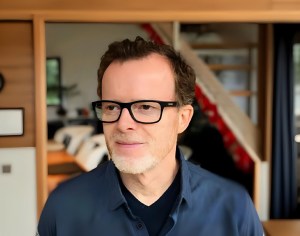
Jose Cruz is the founder and managing director of Integrated Projects, a prominent global building intelligence firm that offers impeccable design services in the flexible design industry. Integrated Projects collaborates closely with property owners and operators to digitise, design and scale their commercial real estate portfolios. With a Distinction in Master's Degree in Architecture from Columbia University and a background in leading teams at renowned firms like Robert AM Stern Architects, Tishman Construction, and UA Builders Group, Jose brings a wealth of expertise at the intersection of architecture, construction, and technology. His focus on integrated, data-driven approaches has proven invaluable in real estate development.
Jose joined Sara Kolata, the founder of Disrupt Symposium at Arch Talk: Tank podcast to discuss the strategic aspects of the business of architecture and tactics that position architectural practices in the market.

Strategy: Principles and Implementation
“Strategy is making trade-offs and choices to establish a competitive advantage in the market. It is a deep understanding of what you refrain from doing and giving importance to what you decide to pursue.”
Jose Luis Cruz
Jose defines strategic positioning with respect to strategy formation in business: A clear picture of what you exclude shows your complete commitment to becoming the best at necessary things. Strategy creation involves a deliberate approach to long-term goals and maintaining a clear focus. Impulsively reacting to short-term trends and mimicking industry competitors leads to stagnancy after a certain point.
Jose refers to Michael Porter’s essay titled “What is Strategy”, generally taught in business schools, emphasising the distinction between true strategy and operational excellence. The ambiguity between the two terms drives people to be tactical and rigid in their way of business.
In the AEC industry, it is important to define our target clientele and sustainable competitive advantage. Organisations should identify whom they provide exceptional services to and acknowledge the fact that they cannot cater to everyone’s needs. The market provides room for benefits to all types of clients but companies need to be selective and make decisions to serve their ideal clients. This approach influences the subsequent operational decisions regarding the company’s focus areas.

Strategies for Integrated Projects
While creating strategies for Integrated Projects, Jose and his team carefully assessed the broader landscape of the design industry - understanding potential demand areas, identifying clients, and recognising their general needs. To their surprise, a lot of valuable insights were received from outside the design industry. The strategy of any company, big or small begins precisely by defining the exact activities that you decide to pursue to provide the best value to its clients. This process is difficult for other companies to imitate and is the backbone of your strategy.
Operational effectiveness or excellence refers to consistently improving existing operations, becoming more efficient and achieving better results at lower costs. While it is vital for any company, strategy is different. One cannot solely rely on operational effectiveness as it can lead to intense competition among companies when they lower prices and profit margins to outclass each other. To avoid this race, it is important to create an entirely new playfield for your company. Instead of competing in a crowded “red ocean” characterised by intense competition and price battles, the goal should be to position yourself in a “blue ocean” with fewer competitions and more growth opportunities.
Red oceans are all of the current industries which are the recognized market areas where industry boundaries are established and businesses compete to gain a larger portion of the market. An intense rivalry turns the sea crimson. Thus, the name "red" oceans. Blue oceans are all the industries that do not yet exist; they are uncharted territory that is free of rivalry and competition. It is large, deep, and potent in terms of opportunity and lucrative growth, much like the "blue" ocean.
At Integrated Projects, Jose and his team serve the commercial sector, particularly the flexible office space market. They chose the new co-working office space trend which provided them with a scope to test their digital space concept and value addition services. In the future, Integrated Projects plans to delve into more specific aspects of their approach such as 3D scanning technology, BIM, Data Science and various other technology platforms.
The key decisions of the company such as the pricing models and the specific technologies you implement are the levers that shape strategy. Each of the levers should complement one another, making it challenging for the competitors to duplicate the unique combination of strategies.

Surviving Competitive Market
“Look at the opportunities, not the competition,” says Jose. He explains his perspective with the help of Henry Ford’s approach when he introduced the mass affordable car model of his company- Model T.
When Henry Ford unveiled the Model T during the 1900s, the automotive landscape was vastly different from what we see today. At that time, the existing car market was affordable only to the elite and wealthy. The notable aspect of Ford’s strategy is that he didn’t set out to compete with the expensive custom tailor-made cars. Instead, he looked at an entirely different mode of transportation- a horse and a buggy. The prime focus area for Ford was affordability and accessibility and not luxurious modes of transportation. Horses and buggies differed from automobiles, both possessing their own sets of advantages and disadvantages. Horse-drawn carriages struggled on uneven roads while cars had steep repair costs. Ford’s innovative approach included reverse-engineering the product by using the price point of a horse and buggy and working backwards to create an affordable car.
Ford’s journey embodied groundbreaking innovations. His story teaches us to find new opportunities, like the “blue ocean”, and not worry about the competition. Begin where the world and reality are. Sometimes, you need to ask different questions and look at things from a different perspective, a different set of factors. As designers and engineers, we often stick to our field but forget to peep into other industries for knowledge to explore diverse influences and industries not directly related to our work, which can lead to innovative ideas and opportunities for growth.

Problem Solving as a Growth Opportunity
Businesses create problem-solving opportunities and Henry Ford’s story underscores how solving a problem can expand your customer base and increase your value. The concept of “blue ocean”, the set of exclusive services you provide as a business unit narrows down to the message you want to convey.
A great example of this unique problem-solving approach is the COVID-19 pandemic and how it has transformed the way the world looks. COVID-19 forced people to be indoors and disconnected them from their day-to-day lives. One of the consequences that severely hit the world was the loss of jobs and the AEC industry was no different. Ongoing projects had come to a halt and in times of extreme financial turmoil, even the best and the most skilled can be disposed of. Everyone embraced digital transformation which was a result of reduced dependency on traditional employment structures and large corporations.
The AEC industry saw this as an opportunity for change and a revolutionary innovation emerged in the form of flexible co-working spaces. More and more people began thinking about starting their businesses, creating room for transformation in the way office spaces are utilised. Unfinished real estate and urban areas created potential for office buildings to emerge making way for more and more startups.
The above example explains how problem-solving can lead to growth and create a set of unique solutions for your business. Having a focused message regarding your services is a strategic positioning tactic that creates opportunities in an evolving business landscape. This evolution is supported by the macro trends in society. In the case of COVID-19, it enabled people flexibility and freedom to not be restricted in a room to work. It changed the way people work and therefore, affected the lifestyle.
We have to understand the needs of the people and try to provide value consistently. For every practice, there is room to create its blue ocean with the set of services it provides, contributing to its strategy creation. Design firms need to brainstorm to create and implement simple strategies that help their business thrive in challenging times. Digital transformation has been a boon to businesses, yet some organisations have failed to completely embrace them although virtual events have eased the accessibility of resources. These digital tools are here to stay.
The world of work is evolving rapidly, and it's essential to adapt. The core principles of strategy, as outlined by Jose, emphasize the importance of making deliberate trade-offs and choices to establish a competitive advantage. Jose urges businesses in the Architecture, Engineering, and Construction (AEC) industry to define their target clientele and sustainable competitive advantage, avoiding the pitfalls of merely pursuing operational excellence. As the world of work undergoes rapid evolution, Jose Cruz's insights serve as a compass for architects and designers, urging them to embrace innovation, stay informed, and consistently deliver value. In an era of digital transformation, where virtual tools become integral, businesses must align with macro trends, understanding the evolving needs of society to carve their own unique "blue ocean."