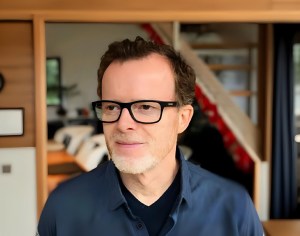
I sat down with Filip Kurasz, founder of an Archviz studio called ELEMENT that comes from my polish hometown, Gdansk to talk to him about freelancing as an Archviz artist and the average customer journey of an architecture firm or a freelance architect, when deciding to hire an Archviz artist to help with rendering.
I hosted a roundtable on the topic: “Freelancing in Architecture” where we had three Archviz artists share their experiences in running their own businesses. You can watch the full video here:
Before we even deep dive into our conversations Filip tells me:

Archviz is a process.
Filip: It is not easy to speak of the business side of your work until you get to a certain level of experience and are able to retrospect on your achievements, your journey and lessons learned. If I was asked to reflect on my industry a few years back, I would probably only be able to focus on the technical aspects of my work, speaking about the power of hyper-realistic renderings. The problem is that you don’t have to be a world champion in 3D graphics to create a good visualisation. Skills are of course important, but they do not guarantee success.
Sara: Tell me what would you say is important when going after clients?
Filip: You have to start from the fact that the process is a set of mutually connected activities, whose realisation is necessary to fulfil the client’s needs – in our case to create a visualisation for his project. A good and, above all, effective visualisation is one that takes into account the needs of the client but is attractive to the recipient. This is where the whole process begins, a process that involves both parties and which, by definition, takes time.
The key is an honest and substantial first conversation. It allows you to avoid many difficult situations and, what is most difficult in my profession, remain objective. I learned a lot from regular interviews with our current clients and from having done architecture myself for 5 years after graduating. If you want to be a good artist you have to be able to ask good questions and interpret the answers accurately. It’s hard for me to imagine that someone who is not an architect can do that, although it does happen.
Sara: What exact things do you need to tick off in the initial meeting?
Filip: In order to enter the project with a clear conscience after the first meeting, I need to know four basic things:
I need to know the project and its principles. For obvious reasons.
I need to know what the purpose of the visualisations is. I need to know if these are competition or marketing images and which key values of the project are to be visible.
I need to know who the target audience is. On this basis, we determine the frames, atmosphere and narrative for each image.
I need to establish the scope of the project, i.e. the number of shots, the deadline for delivering the visuals and the issue of 3D modelling.
Sara: How long does such a conversation last?
Filip: Such a conversation lasts about an hour and allows me to provide a quote for the project, schedule meetings and send a final offer. Taking a client seriously, asking for a price, it’s impossible to do it all on the basis of a single email . I recommend doing some research beforehand. It is worth making an appointment to talk to archviz studios. It does not cost anything, yet it will only give you more knowledge about what and how can be done to present your project well. Finally, it will allow you to choose the best studio to cooperate with.
Sara: so once we have an appointment, how do you know that the process is good?
Filip: Well, in a way, you can see it for yourself after the first meeting. That is why I recommend it. The first conversation is crucial. If someone from the very beginning focuses on what kind of visualisation they can offer and how they do it, it is immediately clear that this person is focused on making a “beautiful” visualisation. “Beautiful” in his/her understanding. Already at this point, there can be big mismatches between what is attractive to the client and what is attractive to the artist.
What about when the artist agrees to everything? He avoids a deeper conversation and does not ask many questions. On the one hand, you could say that he is just skilled or knows how to fit in with the client. On the other hand, one might have doubts about how he can handle all the client’s ideas.
There is no single recipe for a successful conversation just as there is no single recipe for a successful visualization.
The truth is that after such a conversation we simply have to feel comfortable and feel that the other party understands our needs.
Sara: Is it enough to be a talented artist?
Filip: I am not saying that it is not. But you have to be careful.
Technical skills are important, but they only help create good visualisations and improve their quality. What I said earlier is so important that it cannot be compensated by talent. I observed it among my colleagues at university, I see it among my co-workers and I see it every day in portfolios full of beautiful visions that someone made for themselves over the last six months. Usually, for the project, you have 1 to 2 weeks. What really matters is the team, which consists of people with different competencies and experiences. It’s rare that one person is able to pull off the whole process and create a good visualisation on top of that.
I think it is worth comparing it to architecture. Mere knowledge of regulations and Autocad will not make a well-designed building taking into account the needs of its users with everything brilliantly arranged. The result of such work may differ significantly from the investor’s expectations. It would seem that architects should understand this perfectly, but looking at the number of emails I receive where the first question is a question about the price, I fear that it is quite the opposite.
To be clear, I understand perfectly well the budget issue. What I do not understand is how someone spends weeks, or even worse months, working on a project and finally is willing to make visualisations in a week, choosing the cheapest offer. After all, it is a huge risk.
Sara: Does a visualisation have to be beautiful to be considered good?
Filip: Opinions are divided here and one could say that this is a matter of taste. Some say no, and others say yes. As an artist, I don’t agree with creating visuals that are not attractive to me personally. An attractive image is my best business card. Clients want to work with me because they like my visuals. I understand the client’s needs, I try to identify, interpret and present them because in many cases it is as important as the aesthetics. But don’t kid yourself, not every picture is going to be a work of art. It is simply impossible.