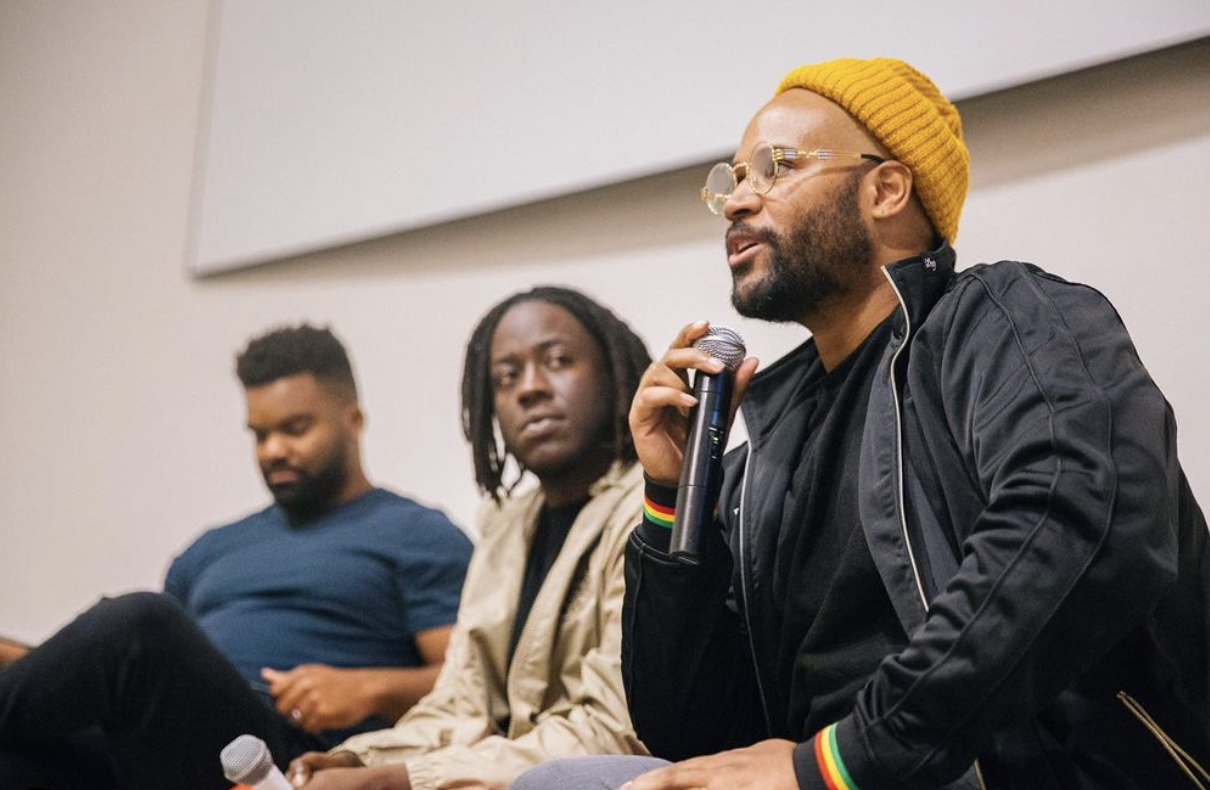
Kevin Sherrod is a design professional with a decade of experience in project design, visualisation, geospatial modelling, and BIM coordination for projects across the U.S. and internationally. He is currently part of Gensler’s Mixed-Use Studio, where he works on high-visibility projects. Originally from Philadelphia, Pennsylvania, Kevin’s design sensibility is rooted in his living experiences growing up in an urban centre, and his 20-plus years of experience serving in grassroots organisations. He is fueled by his commitment to advancing social and racial justice through design and is an emerging thought leader in community-based participatory design. Kevin holds a Bachelor of Architecture from the Southern California Institute of Architecture (SCI-Arc) where he was the first black student body president, and a Master of Architecture and Urban Design from UCLA.


Navigating Careers
Kevin's architectural journey began at the first four-year architecture undergraduate program at a high school initiated by the AIA Philadelphia chapter. This unique program, established to address the lack of diversity in architecture, focused on fostering architectural knowledge and creative expression among minority communities. The curriculum at the high school incorporated various creative disciplines alongside architecture such as fashion design. Despite being the first-of-its-kind school in the United States, Kevin disliked everything about architecture at the school. The intense studio hours felt like an eternity, and the social dynamics around high school made him feel trapped and resentful. To overcome his contempt, Kevin began to explore creative expression through dance, joining an organisation in South Philadelphia. He then enrolled as a dancer at a prestigious dance university, exploring dance as an art form and striving to implement it into architecture.
Football once held Kevin’s dreams, but an unexpected injury transitioned him into dance when rehabilitation became a revelation, unlocking hidden talent and showing signs of a promising career. But amidst the accolades and applauses, a quiet moment at a ballet bar at the peak of his dancing career in his youth raised an important question regarding the long-term viability of the profession. Though an excellent dancer, Kevin yearned for a different way to contribute to the world, a desire that led him to abandon his dance scholarship and explore paths beyond the dance floor.
Hailing from a design and architecture high school, Kevin had all the creative tools necessary for a successful career. But he failed to express his skills on paper. To overcome this, he enrolled in a community college to foster personal growth and embarked on a five-year graduation programme. At this point, financial turmoil and an inner city background with a lack of access to resources and opportunities obstructed Kevin’s journey, after which he landed in Los Angeles with minimal funds. He leveraged his ballet training skills to afford an education at an SCI-Arc, the local community college where supportive programs and services facilitated a smooth journey for him.
While transitioning into SCI-Arc at California, the institute known for its avant-garde approach, Kevin realised the importance of creative growth as an architect. But even at SCI-Arc, financial troubles persisted, putting his graduation at risk. An individual named Thom Mayne helped Kevin with his thesis and graduation, along with all his preparations centred around every opportunity that came his way.
“When preparation and opportunity collide, it creates a whole new world, where every moment reflects your path to success. All you need is your creative lens to seize the moment and claim your triumph,” says Kevin.


Working at Gensler
Gensler, a globally recognised 60000-people firm, holds a firm belief in the value of individual goals and interests in creating a larger positive impact. Here Kevin worked with a creative team comprising five to six individuals who were focused on addressing contemporary issues, particularly homelessness and community inequities in Los Angeles. At Gensler, Kevin has mainly worked on projects such as permanent supportive housing, teen centres, and a black-owned art gallery in Los Angeles. Kevin’s work has allowed him to utilise his creativity in unexpected and fulfilling ways. The collaboration on a project with Debbie Allen Dance Academy marked a full-circle moment in Kevin’s career, from starting as a dancer to contributing to a project at the intersection of dance and architecture. Today he finds immense joy and satisfaction in participating in projects that provide a sense of giving back to the community.
Environmental and Sustainable Projects
In his projects, Kevin engages in critical work, challenging conventional notions. For instance, in one of the parks he designed, the design seems straightforward but in reality, it conceals extensive infrastructure beneath, challenging the simplicity often overlooked with such spaces. Such projects exhibit the disconnect between the urban planning aspirations of a city and the intricate infrastructure needed to sustain them. Sustainable technologies incorporated in projects help the cities meet bigger climate and resilience goals.
Throughout his work, Kevin maintains a delicate balance between seriousness and playfulness. While his project addresses critical issues, he is fearless in blending wit and humour. He collaborated on the South Sea Pearl project with Thom Mayne, where he developed an “X” shaped island in the middle of an ocean. He was quite doubtful of its need in the middle of an ocean with extensive undeveloped land existing to the island’s east. With the project, Kevin not only addressed sustainability and efficiency concerns but also incorporated playful elements into his design.
“Design should be intentional, but not devoid of joy. Similarly, one should not take themselves too seriously, as amidst life’s uncertainties, a good laugh can be a powerful ally,” he says.
This intentional playfulness allows him to navigate the complex landscape of architecture while retaining a sense of humility. While practical considerations in architectural projects are vital, pushing the boundaries at the imaginative and unexpected stage holds immense value. By infusing humour and absurdness into the design, Kevin aims to challenge conventional approaches in urban planning, resource utilisation and human-centric design. His projects serve as a vehicle to question established norms and highlight the often overlooked alternatives, demonstrating that architecture can be crucial in reshaping perspectives and fostering creativity.


Philosophy on Teaching and Views on Education
Kevin considers education as a service, a skill and muscle that requires constant effort. His commitment to teaching comes from his own experience of not encountering anyone like himself during his extensive architecture school.
According to Kevin, “Teaching should be an outpouring of yourself, without expecting anything in return.”
Kevin’s course structure revolves around Geographic Information Systems (GIS), providing a unique architectural lens to examine multidisciplinary disciplines. The course taught by Kevin aims to make data accessible, promoting informed decisions, and equitable decision-making.
The course aims to address data collection practices in architecture, where information is often extracted from communities without their full consent and used for purposes not benefiting them. To break this cycle, the course advocates for a shift towards a more cyclical and intergenerational approach which revolves around empowering communities to become stewards of their data. By effectively educating and representing them, a more equitable and sustainable future for data collection and use can be created. This raises the question: how can we achieve this?
Kevin underscores the importance of the co-creative model in education, emphasising its importance in collaboration, equity and justice in design. This model promotes a holistic understanding of how architecture connects with community engagement. Integrating such topics into the curriculum is crucial, especially for those who may not readily perceive data issues. Ultimately, the increasing inclusion of these topics in architecture education aims to raise awareness and build towards a future where design is both inclusive and empowers architects to be responsible stewards of data.


Upcoming Endeavours
In the near future, Kevin aims to be in service to the people of his community: the black and brown individuals. Kevin has been researching the co-creation model to enable cyclical conversations between himself, Gensler and his community, thus taking it beyond the professional realm. He recognises the historical struggles that the community has faced and aims to be visible to them, establishing conversations around their incredible resilience, to empower and amplify their voices.
The projects Kevin engages in, such as the art gallery and teen centres, are not just architectural endeavours but vehicles for social change. By intertwining architecture with education, he creates spaces that serve as cultural relics, preserving and telling the stories of communities. Kevin's intentional and thoughtful approach to design aims to challenge preconceptions, question societal norms, and contribute to a more inclusive built environment.
Key Learnings from Kevin’s Journey
Kevin emphasises that the key to learning from his journey is embracing discomfort. According to him, creative expression plays a significant role in navigating life’s complexities. Shaping buildings is similar to dealing with life’s political and economic forces. In his post-graduation at SCI-Arc, Kevin nearly missed passing his final semester, breaking all hopes of getting a fellowship. Teaching became an unexpected solution for him, showcasing how closed doors can lead to surprising opportunities. Kevin's experience highlights the resilience required in the face of adversity and the potential for unforeseen opportunities to emerge.
“Success should not be measured from external benchmarks. It is subjective, unique to every individual.”
Kevin Sherrod
Kevin’s architecture journey was no less than a self-discovery of himself, rooted in creative expression and relating to the physical, intellectual and built environment. Despite an initial dislike for architecture, it became a manifestation of Kevin’s real identity as an individual.
Kevin's journey, characterised by self-design and resilience, reflects a life shaped by overcoming obstacles, from geographical limitations to financial challenges. He sees these hurdles not as roadblocks but as integral parts of life's journey. Ambition and determination fueled his progress, from facing financial adversities to pursuing education at prestigious institutions like SCI-Arc. Kevin's perspective emphasises the importance of fearless observation when facing life's challenges, acknowledging the blend of lack and opportunity. His biggest takeaway from this transformative journey is a profound lesson in fearlessly manoeuvring obstacles and turning them into stepping stones for personal and professional growth.